


Binary GCD algorithm
Algorithm that computes the greatest common divisor of two integers using only arithmetic shifts, comparisons, and subtraction
The binary GCD algorithm, also known as Stein's algorithm or the binary Euclidean algorithm, is an algorithm that computes the greatest common divisor (GCD) of two nonnegative integers. Stein's algorithm uses simpler arithmetic operations than the conventional Euclidean algorithm; it replaces division with arithmetic shifts, comparisons, and subtraction.
Nº Q622328 ★
Common · Knowledge
Binary GCD algorithm
Algorithm that computes the greatest common divisor of two integers using only arithmetic shifts, comparisons, and subtraction
The binary GCD algorithm, also known as Stein's algorithm or the binary Euclidean algorithm, is an algorithm that computes the greatest common divisor (GCD) of two nonnegative integers. Stein's algorithm uses simpler arithmetic operations than the conventional Euclidean algorithm; it replaces division with arithmetic shifts, comparisons, and subtraction.
From Wikipedia
The binary GCD algorithm, also known as Stein's algorithm or the binary Euclidean algorithm, is an algorithm that computes the greatest common divisor (GCD) of two nonnegative integers. Stein's algorithm uses simpler arithmetic operations than the conventional Euclidean algorithm; it replaces division with arithmetic shifts, comparisons, and subtraction. Although the algorithm in its contemporary form was first published by the physicist and programmer Josef Stein in 1967, it was known by the 2nd century BCE, in ancient China.
Text: Wikipédia, CC BY-SA 4.0. · Image: Cmglee (CC BY-SA 3.0) ·
Related cards
-
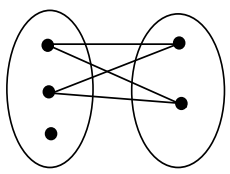
Bipartite graph
Graph whose vertices can be divided into two disjoint and independent sets
Nº Q174733 ★★
Not listed
-

Sieve of Eratosthenes
Ancient algorithm for generating prime numbers
Nº Q177898 ★★★
Not listed
-

Weisfeiler Leman graph isomorphism test
Heuristic algorithm for testing whether two graphs are isomorphic
Nº Q113844288 ★
Not listed
-

Diophantine approximation
Approximating real numbers with rational numbers
Nº Q1227061 ★★
Not listed
-
W
Whittaker–Shannon interpolation formula
Signal (re-)construction algorithm
Nº Q2018853 ★
Not listed
-
H
Halley's method
Method of numerically finding roots of a function
Nº Q1476051 ★
Not listed
-
A
Arithmomania
Mental disorder whereby someone has a strong need to count their actions or nearby objects
Nº Q748104 ★★
Not listed
-
S
Short division
Way to break a division problem into smaller steps
Nº Q105834438 ★★
Not listed
-

Doubling the cube
Geometric problem of constructing a cube with twice the volume of a given cube
Nº Q213673 ★★
Not listed
-
T
Top-p sampling
Language model technique
Nº Q122237668 ★
Not listed
-

Euler's identity
E ^ (πi) + 1 = 0
Nº Q204819 ★★★
Not listed
-

Binary search tree
Data structure in tree form with 0, 1, or 2 children per node, sorted for fast lookup
Nº Q623818 ★★
Not listed