


Binary GCD algorithm
Algorithm that computes the greatest common divisor of two integers using only arithmetic shifts, comparisons, and subtraction
The binary GCD algorithm, also known as Stein's algorithm or the binary Euclidean algorithm, is an algorithm that computes the greatest common divisor (GCD) of two nonnegative integers. Stein's algorithm uses simpler arithmetic operations than the conventional Euclidean algorithm; it replaces division with arithmetic shifts, comparisons, and subtraction.
Nº Q622328 ★
Common · Knowledge
Binary GCD algorithm
Algorithm that computes the greatest common divisor of two integers using only arithmetic shifts, comparisons, and subtraction
The binary GCD algorithm, also known as Stein's algorithm or the binary Euclidean algorithm, is an algorithm that computes the greatest common divisor (GCD) of two nonnegative integers. Stein's algorithm uses simpler arithmetic operations than the conventional Euclidean algorithm; it replaces division with arithmetic shifts, comparisons, and subtraction.
From Wikipedia
The binary GCD algorithm, also known as Stein's algorithm or the binary Euclidean algorithm, is an algorithm that computes the greatest common divisor (GCD) of two nonnegative integers. Stein's algorithm uses simpler arithmetic operations than the conventional Euclidean algorithm; it replaces division with arithmetic shifts, comparisons, and subtraction. Although the algorithm in its contemporary form was first published by the physicist and programmer Josef Stein in 1967, it was known by the 2nd century BCE, in ancient China.
Text: Wikipédia, CC BY-SA 4.0. · Image: Cmglee (CC BY-SA 3.0) ·
Related cards
-
G
Gilbert–Johnson–Keerthi distance algorithm
Method of determing minimum distance between two convex sets
Nº Q4060668 ★
Not listed
-
Q
Quadratic unconstrained binary optimization
Combinatorial optimization problem
Nº Q7268372 ★
Not listed
-

Pohlig–Hellman algorithm
Algorithm for computing discrete logarithms
Nº Q1755812 ★
Not listed
-
B
Bailey–Borwein–Plouffe formula
Formula for calculating π
Nº Q803807 ★
Not listed
-
K
Kabsch algorithm
Type of algorithm
Nº Q6344361 ★
Not listed
-

Common logarithm
The logarithm with base 10, formerly widely used for calculations
Nº Q966582 ★★★
Not listed
-

Gnome sort
Sorting algorithm
Nº Q936797 ★
Not listed
-
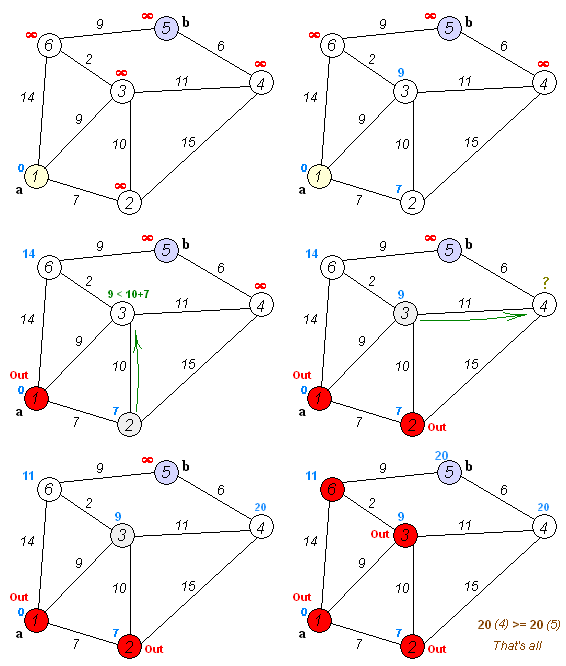
Dijkstra's algorithm
Graph search algorithm
Nº Q8548 ★★★★
Not listed
-

Simon Plouffe
Canadian mathematician
Nº Q983306 ★
Not listed
-
P
Partition problem
NP-complete problem in computer science
Nº Q1065968 ★
Not listed
-

Grover's algorithm
Quantum unstructured search algorithm that finds with high probability the unique input to a black box function that produces a particular output value using 𝑂(𝑁) evaluations
Nº Q1028292 ★★
Not listed
-

Quicksort
Divide and conquer sorting algorithm
Nº Q486598 ★★★★
Not listed
-

Binary space partitioning
Method for recursively subdividing a space into two subsets using hyperplanes
Nº Q863513 ★★
Not listed
-
K
Kaprekar's routine
Iterative algorithm
Nº Q18413622 ★★★★
Not listed
-

Bernstein–Vazirani algorithm
Quantum algorithm
Nº Q65053013 ★
Not listed
-
G
Gauss–Legendre algorithm
Quadratically converging iterative algorithm for computing π
Nº Q2448949 ★
Not listed
-
P
Pollard's kangaroo algorithm
Algorithm for computing the discrete logarithm
Nº Q1911970 ★
Not listed
-
B
Brent's method
Root-finding algorithm
Nº Q905988 ★
Not listed