

Pole–zero plot
In mathematics, signal processing and control theory, a pole–zero plot is a graphical representation of a rational transfer function in the complex plane which helps to convey certain properties of the system such as: Stability Causal system / anticausal system Region of convergence (ROC) Minimum phase / non minimum phase A pole-zero plot shows the location in the complex plane of the poles and zeros of the transfer function of a dynamic system, such as a controller, compensator, sensor, equalizer, filter, or communications channel. By conventi...
Nº Q2100961 ★
Common · Literature
Pole–zero plot
In mathematics, signal processing and control theory, a pole–zero plot is a graphical representation of a rational transfer function in the complex plane which helps to convey certain properties of the system such as: Stability Causal system / anticausal system Region of convergence (ROC) Minimum phase / non minimum phase A pole-zero plot shows the location in the complex plane of the poles and zeros of the transfer function of a dynamic system, such as a controller, compensator, sensor, equalizer, filter, or communications channel. By conventi...
From Wikipedia
In mathematics, signal processing and control theory, a pole–zero plot is a graphical representation of a rational transfer function in the complex plane which helps to convey certain properties of the system such as: Stability Causal system / anticausal system Region of convergence (ROC) Minimum phase / non minimum phase A pole-zero plot shows the location in the complex plane of the poles and zeros of the transfer function of a dynamic system, such as a controller, compensator, sensor, equalizer, filter, or communications channel. By convention, the poles of the system are indicated in the plot by an X while the zeros are indicated by a circle or O. A pole-zero plot is plotted in the plane of a complex frequency domain, which can represent either a continuous-time or a discrete-time system: Continuous-time systems use the Laplace transform and are plotted in the s-plane: s = σ + j ω {\displaystyle s=\sigma +j\omega } Real frequency components are along its vertical axis (the imaginary line s = j ω {\displaystyle s{=}j\omega } where σ = 0 {\displaystyle \sigma {=}0} ) Discrete-time systems use the Z-transform and are plotted in the z-plane: z = A e j ϕ {\displaystyle z=Ae^{j\phi }} Real frequency components are along its unit circle
Text: Wikipédia, CC BY-SA 4.0. ·
Related cards
-
Z
Zero-order hold
Model of signal reconstruction in digital-to-analog (DAC) converters
Nº Q2907060 ★
Not listed
-

Signed zero
Zero with an associated sign
Nº Q217675 ★
Not listed
-
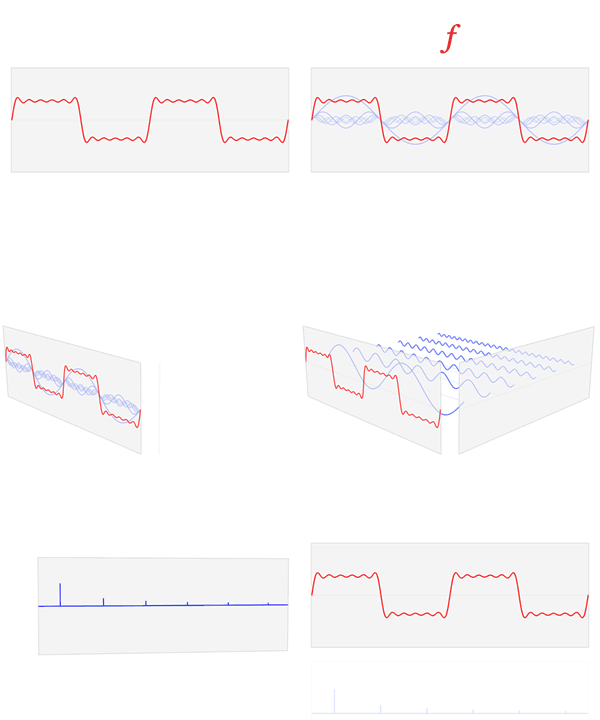
Frequency domain
Signal representation
Nº Q786423 ★
Not listed
-
G
Gauss–Kuzmin–Wirsing operator
Mathematical concept
Nº Q3354602 ★
Not listed
-

Earth's rotation
Rotation of Earth around its axis
Nº Q244743 ★★★★
Not listed
-

Utility pole
Post used by public utilities to support overhead wires and related equipment
Nº Q1144084 ★★★
Not listed
-

Log–log plot
Plot that uses logarithmic scales on both the horizontal and vertical axes
Nº Q2091879 ★
Not listed
-
R
Rational root theorem
Theorem
Nº Q180345 ★★
Not listed
-
O
Optical transfer function
Function that specifies how different spatial frequencies are handled by the system; describes how the optics project light from the object or scene onto a photographic film, detector array, retina, screen, etc.
Nº Q1942321 ★★
Not listed
-
I
Impedance of free space
Physical constant relating the magnitudes of the electric and magnetic fields of electromagnetic radiation travelling through free space
Nº Q269492 ★
Not listed
-

Argument (complex analysis)
Angle of complex number about real axis
Nº Q1780131 ★★
Not listed
-

Savitzky–Golay filter
Algorithm to smoothen data points
Nº Q1228952 ★★
Not listed
-

Chebyshev nodes
Real algebraic numbers, roots of the Chebyshev polynomials of the first kind
Nº Q1052508 ★
Not listed
-
P
PL/0
Programming language, intended as an educational programming language, that is similar to but much simpler than Pascal
Nº Q1719128 ★
Not listed
-

Poisson bracket
Bilinear differential operation on scalar fields on a symplectic (or, more generally, Poisson) manifold
Nº Q1052775 ★★
Not listed
-
L
Linearization
Finding linear approximation of function at given point
Nº Q1520713 ★
Not listed
-

Zero to the power of zero
Mathematical expression with no necessarily obvious value
Nº Q6139783 ★★★★
Not listed
-
M
Mellin transform
Mathematical operation
Nº Q606934 ★★
Not listed