

Randomized algorithm
Algorithm designed to use randomness from auxiliary inputs as part of its logic
A randomized algorithm is an algorithm that employs a degree of randomness as part of its logic or procedure. The algorithm typically uses uniformly random bits as an auxiliary input to guide its behavior, in the hope of achieving good performance in the "average case" over all possible choices of random determined by the random bits; thus either the running time, or the output (or both) are random variables.
Nº Q583461 ★
Common · History
Randomized algorithm
Algorithm designed to use randomness from auxiliary inputs as part of its logic
A randomized algorithm is an algorithm that employs a degree of randomness as part of its logic or procedure. The algorithm typically uses uniformly random bits as an auxiliary input to guide its behavior, in the hope of achieving good performance in the "average case" over all possible choices of random determined by the random bits; thus either the running time, or the output (or both) are random variables.
From Wikipedia
A randomized algorithm is an algorithm that employs a degree of randomness as part of its logic or procedure. The algorithm typically uses uniformly random bits as an auxiliary input to guide its behavior, in the hope of achieving good performance in the "average case" over all possible choices of random determined by the random bits; thus either the running time, or the output (or both) are random variables. There is a distinction between algorithms that use the random input so that they always terminate with the correct answer, but where the expected running time is finite (Las Vegas algorithms, for example Quicksort), and algorithms which have a chance of producing an incorrect result (Monte Carlo algorithms, for example the Monte Carlo algorithm for the MFAS problem) or fail to produce a result either by signaling a failure or failing to terminate. In some cases, probabilistic algorithms are the only practical means of solving a problem. In common practice, randomized algorithms are approximated using a pseudorandom number generator in place of a true source of random bits; such an implementation may deviate from the expected theoretical behavior and mathematical guarantees which may depend on the existence of an ideal true random number generator.
Text: Wikipédia, CC BY-SA 4.0. ·
Related cards
-

The Algorithm
French musician
Nº Q7713096 ★
Not listed
-

Algebraic structure
Set equipped with one or more finitary operations defined on it
Nº Q205464 ★★
Not listed
-

Natural language generation
Automatic text generation using a computer algorithm
Nº Q1513879 ★
Not listed
-

Median of medians
Selection algorithm
Nº Q3631803 ★
Not listed
-
R
Resolution (logic)
In logic, rule of inference
Nº Q1051925 ★★
Not listed
-
V
Validated numerics
Numerics including mathematically strict error evaluation
Nº Q63307393 ★
Not listed
-
K
Key size
Number of bits in a key used by a cryptographic algorithm
Nº Q1557574 ★
Not listed
-
R
Renormalization group
Method for using scale changes to understand physical theories such as quantum field theories
Nº Q1203669 ★★
Not listed
-

Supervised learning
Machine learning task of learning a function that maps an input to an output based on example input-output pairs
Nº Q334384 ★★
Not listed
-
B
Best-first search
Algorithm
Nº Q830527 ★
Not listed
-

Ray (optics)
In geometrical optics: an idealized model of light; a line that is perpendicular to the wavefronts of the actual light, and that points in the direction of energy flow
Nº Q633620 ★
Not listed
-

Latent Dirichlet allocation
Generative statistical model that allows sets of observations to be explained by unobserved groups that explain why some parts of the data are similar
Nº Q269236 ★
Not listed
-
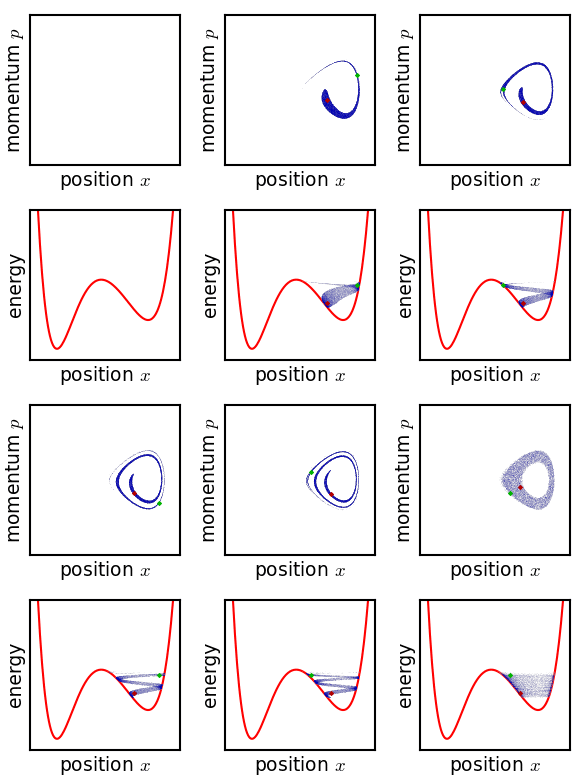
Ergodic theory
Branch of mathematics that studies dynamical systems
Nº Q5498822 ★★★
Not listed
-
G
Generic cell rate algorithm
Network scheduling algorithm used in ATM
Nº Q5532665 ★
Not listed
-

Domain of a function
Set of "input" or argument values for which a function is defined
Nº Q192439 ★★★
Not listed
-

Ramp function
Piecewise function that clamps its input to be non-negative
Nº Q1047481 ★
Not listed
-

Noise (electronics)
Random fluctuation in an electrical signal
Nº Q11306265 ★★
Not listed
-
Q
Quantum programming
Computer programming approach dedicated to quantum computers
Nº Q4218497 ★
Not listed