

Randomized algorithm
Algorithm designed to use randomness from auxiliary inputs as part of its logic
A randomized algorithm is an algorithm that employs a degree of randomness as part of its logic or procedure. The algorithm typically uses uniformly random bits as an auxiliary input to guide its behavior, in the hope of achieving good performance in the "average case" over all possible choices of random determined by the random bits; thus either the running time, or the output (or both) are random variables.
Nº Q583461 ★
Common · History
Randomized algorithm
Algorithm designed to use randomness from auxiliary inputs as part of its logic
A randomized algorithm is an algorithm that employs a degree of randomness as part of its logic or procedure. The algorithm typically uses uniformly random bits as an auxiliary input to guide its behavior, in the hope of achieving good performance in the "average case" over all possible choices of random determined by the random bits; thus either the running time, or the output (or both) are random variables.
From Wikipedia
A randomized algorithm is an algorithm that employs a degree of randomness as part of its logic or procedure. The algorithm typically uses uniformly random bits as an auxiliary input to guide its behavior, in the hope of achieving good performance in the "average case" over all possible choices of random determined by the random bits; thus either the running time, or the output (or both) are random variables. There is a distinction between algorithms that use the random input so that they always terminate with the correct answer, but where the expected running time is finite (Las Vegas algorithms, for example Quicksort), and algorithms which have a chance of producing an incorrect result (Monte Carlo algorithms, for example the Monte Carlo algorithm for the MFAS problem) or fail to produce a result either by signaling a failure or failing to terminate. In some cases, probabilistic algorithms are the only practical means of solving a problem. In common practice, randomized algorithms are approximated using a pseudorandom number generator in place of a true source of random bits; such an implementation may deviate from the expected theoretical behavior and mathematical guarantees which may depend on the existence of an ideal true random number generator.
Text: Wikipédia, CC BY-SA 4.0. ·
Related cards
-

Rendering (computer graphics)
Producing image of 3D scene from precise specification using computer
Nº Q176953 ★★★
Not listed
-

Analytics
Discovery, interpretation, and communication of meaningful patterns in data
Nº Q485396 ★★★
Not listed
-

Gradient descent
Optimization algorithm
Nº Q1199743 ★★★
Not listed
-
T
Tomasulo's algorithm
Computer architecture hardware algorithm
Nº Q1937058 ★
Not listed
-
S
Stein's lemma
Theorem of probability theory
Nº Q7606741 ★
Not listed
-
D
Dual EC DRBG
Controversial pseudorandom number generator
Nº Q309607 ★★
Not listed
-
D
Digital differential analyzer (graphics algorithm)
Hardware or software used for interpolation of variables over an interva
Nº Q2247908 ★
Not listed
-
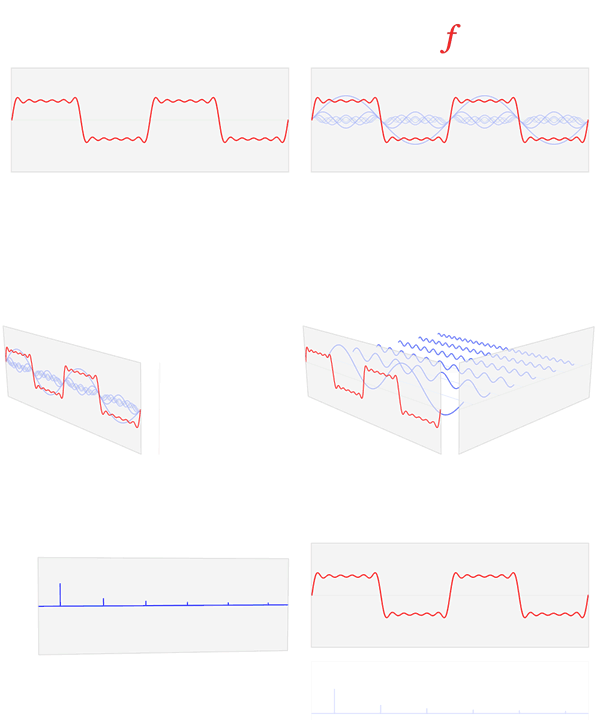
Time domain
Analysis of math functions with respect to time
Nº Q185889 ★
Not listed
-
T
Turing completeness
Ability of a computing system to simulate Turing machines
Nº Q197970 ★★★
Not listed
-

Hardware acceleration
Use of specialized computer hardware to perform some functions more efficiently than is possible in software running on a more general-purpose CPU
Nº Q600158 ★
Not listed
-

Universal Turing machine
Turing machine that can simulate an arbitrary Turing machine on arbitrary input by reading both the description of the machine to be simulated as well as the input thereof from its own tape
Nº Q2703890 ★★
Not listed
-
G
Goertzel algorithm
Algorithm
Nº Q1472192 ★★
Not listed
-

Strategy pattern
Design pattern enabling selection of algorithms at runtime
Nº Q775349 ★★
Not listed
-

Ant colony optimization algorithms
Probabilistic techniques for solving computational problems that can be reduced to finding good paths through graphs
Nº Q460851 ★★
Not listed
-
R
Request–response
Method by which computers communicate
Nº Q7314785 ★★
Not listed
-
M
Mixed model
Statistical model containing both fixed effects and random effects
Nº Q1501135 ★★
Not listed
-

Binary GCD algorithm
Algorithm that computes the greatest common divisor of two integers using only arithmetic shifts, comparisons, and subtraction
Nº Q622328 ★
Not listed
-

Total variation denoising
Noise removal process during image processing
Nº Q7828156 ★
Not listed