

TI-BASIC
Programming language used in Texas Instruments calculators
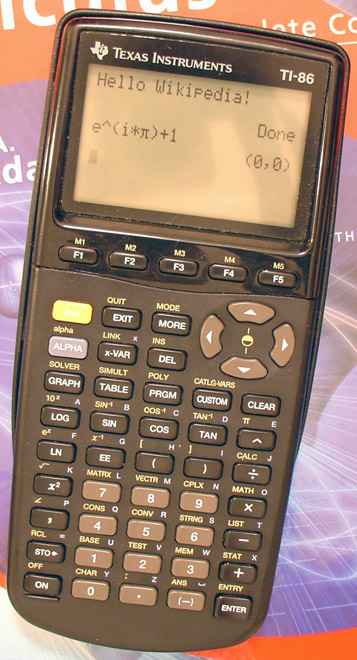
TI-BASIC is the official name of several BASIC-like programming languages used by Texas Instruments' graphing calculators. It is a language family of three different and incompatible versions, released on different products: TI-BASIC 83 (on Z80 processor) for TI-83 series, TI-84 Plus series TI-BASIC 89 (on 68k processor) for TI-89 series, TI-92 series TI-BASIC Nspire (on ARM processor) for TI Nspire series TI rarely refers to the language by name, but the name TI-BASIC has been used in some developer documentation.
Nº Q1759833 ★
Common · Knowledge
TI-BASIC
Programming language used in Texas Instruments calculators
TI-BASIC is the official name of several BASIC-like programming languages used by Texas Instruments' graphing calculators. It is a language family of three different and incompatible versions, released on different products: TI-BASIC 83 (on Z80 processor) for TI-83 series, TI-84 Plus series TI-BASIC 89 (on 68k processor) for TI-89 series, TI-92 series TI-BASIC Nspire (on ARM processor) for TI Nspire series TI rarely refers to the language by name, but the name TI-BASIC has been used in some developer documentation.
From Wikipedia
TI-BASIC is the official name of several BASIC-like programming languages used by Texas Instruments' graphing calculators. It is a language family of three different and incompatible versions, released on different products: TI-BASIC 83 (on Z80 processor) for TI-83 series, TI-84 Plus series TI-BASIC 89 (on 68k processor) for TI-89 series, TI-92 series TI-BASIC Nspire (on ARM processor) for TI Nspire series TI rarely refers to the language by name, but the name TI-BASIC has been used in some developer documentation. For many applications, it is the most convenient way to program any TI calculator, since the capability to write programs in TI-BASIC is built-in. Assembly language can also be used, and C compilers exist for translation into assembly: TIGCC for Motorola 68000 (68k) based calculators, and SDCC for Zilog Z80 based calculators. However, both of them are cross-compilers, not allowing on-calculator programming. TI-BASIC is considerably slower than the assembly language (because it has to be interpreted), making it better suited to writing programs to quickly solve math problems or perform repetitive tasks, rather than programming games or graphics-intensive applications. Some math instruction books even provide programs in TI-BASIC (usually for the widespread variant used by the TI-82/83/84 series). Although it is somewhat minimalist compared to programming languages used on computers, TI-BASIC is nonetheless an important factor in the programming community. Because TI graphing calculators are required for advanced mathematics classes in many high schools and universities, TI-BASIC often provides the first glimpse many students have into the world of programming.
Text: Wikipédia, CC BY-SA 4.0. · Image: Wikimedia Commons (CC BY-SA 3.0) ·
Related cards
-

Calculator spelling
Method of writing text on seven-segment displays
Nº Q814320 ★★★
Not listed
-

HP 49/50 series
Series of graphing calculators by Hewlett-Packard
Nº Q3338809 ★
Not listed
-

Turbo Basic
Programming language
Nº Q1306585 ★
Not listed
-
A
Ascii85
Form of binary-to-text encoding developed by Paul E. Rutter
Nº Q809819 ★
Not listed
-

Family BASIC
1984 programming cartridge
Nº Q3066239 ★★
Not listed
-

TK95
Brazilian ZX Spectrum clone made in 1986 by Microdigital Electrônica
Nº Q4862357 ★★
Not listed
-
B
Base62
Positional notation using 0-9, A-Z, and a-z
Nº Q809817 ★
Not listed
-

Altair BASIC
Interpreter for the BASIC programming language
Nº Q286196 ★
Not listed
-

Zilog Z180
Eight-bit micoprocessor
Nº Q1851918 ★
Not listed
-
I
IDL (programming language)
Programming language
Nº Q1665857 ★
Not listed
-

Texas Instruments signing key controversy
Refers to Texas Instruments' response to a project to factorize cryptographic keys.
Nº Q7707773 ★
Not listed
-

GNU Core Utilities
Package of GNU software containing reimplementations for many of the basic tools, such as cat, ls, and rm, used on Unix-like operating
Nº Q1348204 ★★
Not listed
-

Groq
American artificial intelligence company
Nº Q126050137 ★★★
Not listed
-

Olivetti P652
Programmable calculator
Nº Q43201173 ★
Not listed
-
S
System F
Typed lambda calculus
Nº Q2552799 ★
Not listed
-
H
HarfBuzz
Open source text shaping library
Nº Q4119352 ★
Not listed
-
S
System programming language
Class of computer programming languages
Nº Q4117397 ★
Not listed
-
U
Unistd.h
POSIX C header
Nº Q2065456 ★
Not listed