

TI-BASIC
Programming language used in Texas Instruments calculators
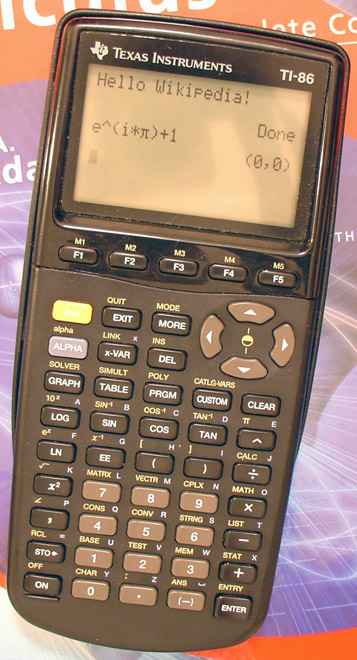
TI-BASIC is the official name of several BASIC-like programming languages used by Texas Instruments' graphing calculators. It is a language family of three different and incompatible versions, released on different products: TI-BASIC 83 (on Z80 processor) for TI-83 series, TI-84 Plus series TI-BASIC 89 (on 68k processor) for TI-89 series, TI-92 series TI-BASIC Nspire (on ARM processor) for TI Nspire series TI rarely refers to the language by name, but the name TI-BASIC has been used in some developer documentation.
Nº Q1759833 ★
Common · Knowledge
TI-BASIC
Programming language used in Texas Instruments calculators
TI-BASIC is the official name of several BASIC-like programming languages used by Texas Instruments' graphing calculators. It is a language family of three different and incompatible versions, released on different products: TI-BASIC 83 (on Z80 processor) for TI-83 series, TI-84 Plus series TI-BASIC 89 (on 68k processor) for TI-89 series, TI-92 series TI-BASIC Nspire (on ARM processor) for TI Nspire series TI rarely refers to the language by name, but the name TI-BASIC has been used in some developer documentation.
From Wikipedia
TI-BASIC is the official name of several BASIC-like programming languages used by Texas Instruments' graphing calculators. It is a language family of three different and incompatible versions, released on different products: TI-BASIC 83 (on Z80 processor) for TI-83 series, TI-84 Plus series TI-BASIC 89 (on 68k processor) for TI-89 series, TI-92 series TI-BASIC Nspire (on ARM processor) for TI Nspire series TI rarely refers to the language by name, but the name TI-BASIC has been used in some developer documentation. For many applications, it is the most convenient way to program any TI calculator, since the capability to write programs in TI-BASIC is built-in. Assembly language can also be used, and C compilers exist for translation into assembly: TIGCC for Motorola 68000 (68k) based calculators, and SDCC for Zilog Z80 based calculators. However, both of them are cross-compilers, not allowing on-calculator programming. TI-BASIC is considerably slower than the assembly language (because it has to be interpreted), making it better suited to writing programs to quickly solve math problems or perform repetitive tasks, rather than programming games or graphics-intensive applications. Some math instruction books even provide programs in TI-BASIC (usually for the widespread variant used by the TI-82/83/84 series). Although it is somewhat minimalist compared to programming languages used on computers, TI-BASIC is nonetheless an important factor in the programming community. Because TI graphing calculators are required for advanced mathematics classes in many high schools and universities, TI-BASIC often provides the first glimpse many students have into the world of programming.
Text: Wikipédia, CC BY-SA 4.0. · Image: Wikimedia Commons (CC BY-SA 3.0) ·
Related cards
-
H
Hardware-in-the-loop simulation
Technique used in the development and test of complex real-time embedded systems
Nº Q1142371 ★★
Not listed
-

64-bit computing
Computer architecture bit width
Nº Q252132 ★★
Not listed
-
M
Mavis Beacon Teaches Typing
Application software program designed to teach touch typing
Nº Q6794240 ★★
Not listed
-

Haxe
Cross-platform open-source programming language
Nº Q285886 ★★
Not listed
-

Visual Basic (.NET)
Programming language for .NET
Nº Q50077 ★★
Not listed
-

Compiler
Computer program that transforms source code into object code
Nº Q47506 ★★★
Not listed
-
E
Elektronika 70
Soviet table professional programmable calculator
Nº Q4530920 ★
Not listed
-
F
F* (programming language)
Functional programming language inspired by ML and aimed at program verification
Nº Q5423569 ★
Not listed
-

Elektronika MK-85
Soviet programmable calculator
Nº Q4530984 ★★
Not listed
-

Z80 instruction set
Microprocessor instruction set
Nº Q135919904 ★
Not listed
-

HP 48 series
Series of Hewlett-Packard calculators
Nº Q1412154 ★★
Not listed
-
S
Stack-oriented programming
Programming paradigm that relies on a stack machine model
Nº Q52845127 ★
Not listed
-
A
ABC (programming language)
Node js
Nº Q1057802 ★
Not listed
-
D
Disassembler
Computer program that translates machine language into assembly language
Nº Q279650 ★★
Not listed
-

Babel (transcompiler)
JavaScript compiler that compiles ES2015+ code into backwards compatible JavaScript for older versions of browsers
Nº Q55604651 ★
Not listed
-
T
TIFF
Series of image file formats
Nº Q215106 ★★★
Not listed
-
F
F (programming language)
Programming language: compiled, structured, array language
Nº Q5427464 ★
Not listed
-
X
X86 calling conventions
Calling conventions used in x86 architecture programming
Nº Q4405409 ★★
Not listed