

Goertzel algorithm
Algorithm
The Goertzel algorithm is a technique in digital signal processing (DSP) for efficient evaluation of the individual terms of the discrete Fourier transform (DFT). It is useful in certain practical applications, such as recognition of dual-tone multi-frequency signaling (DTMF) tones produced by the push buttons of the keypad of a traditional analog telephone.
Nº Q1472192 ★★
Poco común · Saberes
Goertzel algorithm
Algorithm
The Goertzel algorithm is a technique in digital signal processing (DSP) for efficient evaluation of the individual terms of the discrete Fourier transform (DFT). It is useful in certain practical applications, such as recognition of dual-tone multi-frequency signaling (DTMF) tones produced by the push buttons of the keypad of a traditional analog telephone.
En Wikipedia
Texto en inglés Aún no hay artículo en tu idioma: extracto en inglés.
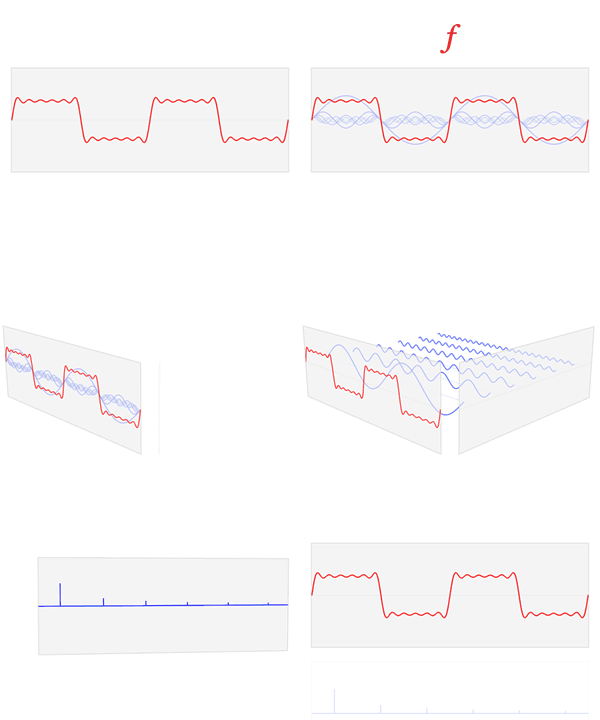
The Goertzel algorithm is a technique in digital signal processing (DSP) for efficient evaluation of the individual terms of the discrete Fourier transform (DFT). It is useful in certain practical applications, such as recognition of dual-tone multi-frequency signaling (DTMF) tones produced by the push buttons of the keypad of a traditional analog telephone. The algorithm was first described by Gerald Goertzel in 1958. Like the DFT, the Goertzel algorithm analyses one selectable frequency component from a discrete signal. Unlike direct DFT calculations, the Goertzel algorithm applies a single real-valued coefficient at each iteration, using real-valued arithmetic for real-valued input sequences. For covering a full spectrum (except when using for continuous stream of data where coefficients are reused for subsequent calculations, which has computational complexity equivalent of sliding DFT), the Goertzel algorithm has a higher order of complexity than fast Fourier transform (FFT) algorithms, but for computing a small number of selected frequency components, it is more numerically efficient. The simple structure of the Goertzel algorithm makes it well suited to small processors and embedded applications. The Goertzel algorithm can also be used "in reverse" as a sinusoid synthesis function, which requires only 1 multiplication and 1 subtraction per generated sample.
Texto: Wikipedia en inglés, CC BY-SA 4.0. ·
Cartas cercanas
-
A
Analizador diferencial digital
Nº Q2247908 ★
Sin ofertas
-

Método de Euler
Nº Q868454 ★★★
Sin ofertas
-

FFTW
Software library for computing discrete Fourier transforms
Nº Q2251820 ★
Sin ofertas
-
D
Dhrystone
Nº Q1207761 ★
Sin ofertas
-

Atkinson dithering
Error-diffusion image dithering algorithm
Nº Q115768171 ★
Sin ofertas
-

Tarjan's strongly connected components algorithm
Graph theory algorithm
Nº Q1972285 ★
Sin ofertas
-

Protocolo de túnel de GPRS
Protocolo de red y comunicación
Nº Q1486488 ★
Sin ofertas
-
a
algoritmo de Markov
String rewriting system that uses grammar-like rules to operate on strings of symbols
Nº Q1900936 ★★
Sin ofertas
-
Dominio del tiempo
Nº Q185889 ★
Sin ofertas
-

Weisfeiler Leman graph isomorphism test
Heuristic algorithm for testing whether two graphs are isomorphic
Nº Q113844288 ★
Sin ofertas
-
a
algoritmo de Kosaraju
Algoritmo para encontrar el componente fuertemente conectado de un gráfico dirigido
Nº Q2655281 ★
Sin ofertas
-

Hercio
Unidad de frecuencia del Sistema Internacional de Unidades
Nº Q39369 ★★★★
Sin ofertas
-

Algoritmo de Floyd-Warshall
Nº Q1047576 ★★
Sin ofertas
-

Algoritmo de Boruvka
Nº Q1468211 ★
Sin ofertas
-
A
Análisis de correspondencias
Técnica descriptiva desarrollada por Jean-Paul Benzécri
Nº Q1784754 ★
Sin ofertas
-

Algoritmo símplex
Método Simplex
Nº Q134164 ★★★
Sin ofertas
-

Conversor de señal digital a analógica
Nº Q210863 ★★★
Sin ofertas
-
T
Teoría de detección de señales
Nº Q120811 ★
Sin ofertas