


Maze-solving algorithm
Automated method for solving mazes
A maze-solving algorithm is an automated method for solving a maze. The random mouse, wall follower, Pledge, Tarry's, and Trémaux's algorithms are designed to be used inside the maze by a traveler with no prior knowledge of the maze, whereas the dead-end filling and shortest path algorithms are designed to be used by a person or computer program that can see the whole maze at once.
Nº Q1606072 ★★
Poco común · Saberes
Maze-solving algorithm
Automated method for solving mazes
A maze-solving algorithm is an automated method for solving a maze. The random mouse, wall follower, Pledge, Tarry's, and Trémaux's algorithms are designed to be used inside the maze by a traveler with no prior knowledge of the maze, whereas the dead-end filling and shortest path algorithms are designed to be used by a person or computer program that can see the whole maze at once.
En Wikipedia
Texto en inglés Aún no hay artículo en tu idioma: extracto en inglés.
A maze-solving algorithm is an automated method for solving a maze. The random mouse, wall follower, Pledge, Tarry's, and Trémaux's algorithms are designed to be used inside the maze by a traveler with no prior knowledge of the maze, whereas the dead-end filling and shortest path algorithms are designed to be used by a person or computer program that can see the whole maze at once. Mazes containing no loops are known as "simply connected", or "perfect" mazes, and are equivalent to a tree in graph theory. Maze-solving algorithms are closely related to graph theory. Intuitively, if one pulled and stretched out the paths in the maze in the proper way, the result could be made to resemble a tree.
Texto: Wikipedia en inglés, CC BY-SA 4.0. · Imagen: Picture taken by Dake (CC BY-SA 3.0) ·
Cartas cercanas
-
M
Método de la regla falsa
Nº Q1476057 ★★
Sin ofertas
-
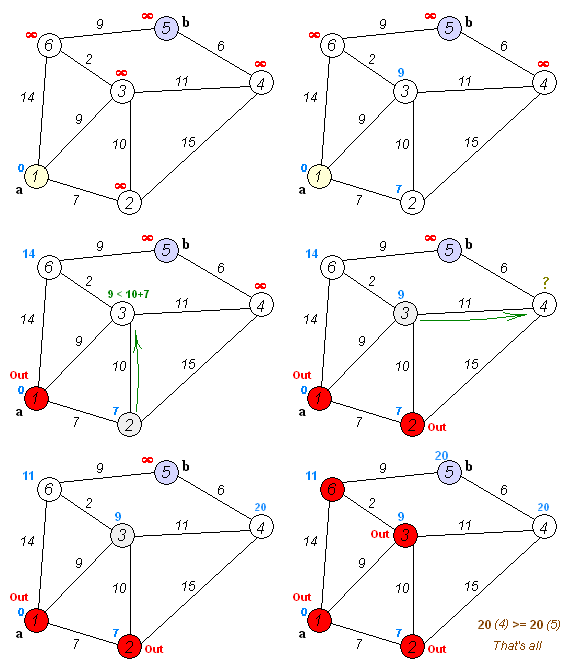
Algoritmo de Dijkstra
Algoritmo para determinar el camino más corto corto en un grafo con pesos en cada arista
Nº Q8548 ★★★★
Sin ofertas
-
L
Learning with errors
Problem in machine learning that is conjectured to be hard to solve. Introduced by Oded Regev in 2005, it is a generalization of the parity learning problem
Nº Q6510239 ★
Sin ofertas
-

Algoritmo de Prim
Nº Q470813 ★★
Sin ofertas
-
M
Máquina Cox-Zucker
Algoritmo en geometría algebraica
Nº Q228693 ★★
Sin ofertas
-
a
algoritmo de Markov
String rewriting system that uses grammar-like rules to operate on strings of symbols
Nº Q1900936 ★★
Sin ofertas
-
A
Algoritmo de Viterbi
Nº Q83886 ★★
Sin ofertas
-

Tarjan's strongly connected components algorithm
Graph theory algorithm
Nº Q1972285 ★
Sin ofertas
-
M
Microsoft Academic Search
Nº Q1065154 ★
Sin ofertas
-

NP-completo
Clase de complejidad
Nº Q215206 ★★★
Sin ofertas
-
M
Minimax
Método de decisión en teoría de juegos
Nº Q751319 ★★★
Sin ofertas
-
a
algoritmo de Kosaraju
Algoritmo para encontrar el componente fuertemente conectado de un gráfico dirigido
Nº Q2655281 ★
Sin ofertas
-
H
Held–Karp algorithm
Solution of the traveling salesman problem
Nº Q20203442 ★
Sin ofertas
-
A
Algoritmo probabilista
Tipo de algoritmo
Nº Q583461 ★
Sin ofertas
-

Árbol de juego
Nº Q1377033 ★
Sin ofertas
-
M
MUSH
Text-based online social medium
Nº Q6719091 ★
Sin ofertas
-
Q
Q-learning
Nº Q2664563 ★★★
Sin ofertas
-

Matriz escalonada
Elemento algebraico matricial sometido a un algoritmo de escalonamiento.
Nº Q2091296 ★★
Sin ofertas