

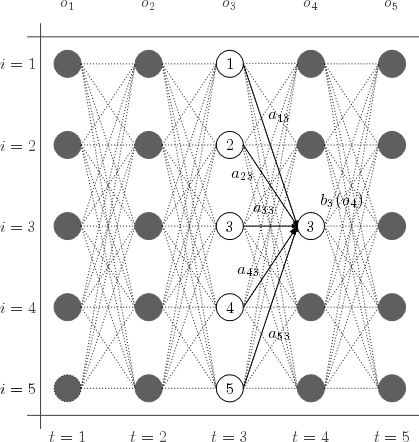
Forward–backward algorithm
Hidden Markov model inference algorithm which computes the posterior marginals of all hidden state variables given a sequence of observations, making use of dynamic programming to make only 2 passes: one forward, one backward
The forward–backward algorithm is an inference algorithm for hidden Markov models which computes the posterior marginals of all hidden state variables given a sequence of observations/emissions o 1 : T := o 1 , … , o T {\displaystyle o_{1:T}:=o_{1},\dots ,o_{T}} , i.e. it computes, for all hidden state variables X t ∈ { X 1 , … , X T } {\displaystyle X_{t}\in \{X_{1},\dots ,X_{T}\}} , the distribution P ( X t | o 1 : T ) {\displaystyle P(X_{t}\ |\ o_{1:T})} . This inference task is usually called smoothing.
Nº Q4909 ★
Comum · Saberes
Forward–backward algorithm
Hidden Markov model inference algorithm which computes the posterior marginals of all hidden state variables given a sequence of observations, making use of dynamic programming to make only 2 passes: one forward, one backward
The forward–backward algorithm is an inference algorithm for hidden Markov models which computes the posterior marginals of all hidden state variables given a sequence of observations/emissions o 1 : T := o 1 , … , o T {\displaystyle o_{1:T}:=o_{1},\dots ,o_{T}} , i.e. it computes, for all hidden state variables X t ∈ { X 1 , … , X T } {\displaystyle X_{t}\in \{X_{1},\dots ,X_{T}\}} , the distribution P ( X t | o 1 : T ) {\displaystyle P(X_{t}\ |\ o_{1:T})} . This inference task is usually called smoothing.
Na Wikipédia
Texto em inglês Ainda não há artigo no seu idioma: trecho em inglês.
The forward–backward algorithm is an inference algorithm for hidden Markov models which computes the posterior marginals of all hidden state variables given a sequence of observations/emissions o 1 : T := o 1 , … , o T {\displaystyle o_{1:T}:=o_{1},\dots ,o_{T}} , i.e. it computes, for all hidden state variables X t ∈ { X 1 , … , X T } {\displaystyle X_{t}\in \{X_{1},\dots ,X_{T}\}} , the distribution P ( X t | o 1 : T ) {\displaystyle P(X_{t}\ |\ o_{1:T})} . This inference task is usually called smoothing. The algorithm makes use of the principle of dynamic programming to efficiently compute the values that are required to obtain the posterior marginal distributions in two passes. The first pass goes forward in time while the second goes backward in time; hence the name forward–backward algorithm. The term forward–backward algorithm is also used to refer to any algorithm belonging to the general class of algorithms that operate on sequence models in a forward–backward manner. In this sense, the descriptions in the remainder of this article refer only to one specific instance of this class.
Texto: Wikipédia em inglês, CC BY-SA 4.0. · Imagem: Enrique Benimeli (CC BY-SA 3.0) ·
Cartas próximas
-
M
Movimento browniano fracionário
Nº Q1143293 ★
Sem ofertas
-

Retropropagação
Algoritmo de otimização para redes neurais artificiais
Nº Q798503 ★★★
Sem ofertas
-
B
Bernstein–von Mises theorem
Theorem that the posterior converges in the infinite-data limit 𝑁≫1 to a multivariate normal distribution centred at the maximum likelihood estimator with covariance 𝑁⁻¹𝐼(𝜃₀)⁻¹ with 𝜃₀ the true population parameter and 𝐼(𝜃₀) the Fisher information
Nº Q4894580 ★
Sem ofertas
-
H
Heath–Jarrow–Morton framework
Financial model
Nº Q1563747 ★
Sem ofertas
-
B
Backward Euler method
Numerical method for solving differential equations
Nº Q2736820 ★★
Sem ofertas
-

Método do gradiente
Método numérico usado em otimização
Nº Q1199743 ★★★
Sem ofertas
-

Modelo oculto de Markov
Modelo estatístico de Markov
Nº Q176769 ★★★
Sem ofertas
-
G
Gillespie algorithm
Method for stochastic equation systems
Nº Q5562121 ★
Sem ofertas
-
A
Análise fatorial
Método estatístico usado para descrever correlações por meio de poucas variáveis latentes
Nº Q726474 ★★
Sem ofertas
-
F
Filtered back projection
Algorithm for tomographic reconstruction of a 2D image from a set of projections
Nº Q20665529 ★
Sem ofertas
-
C
CMA-ES
Algorithm
Nº Q505588 ★★
Sem ofertas
-

Método da transformação inversa
Nº Q1377019 ★
Sem ofertas
-

Amostragem de Gibbs
Nº Q1191905 ★
Sem ofertas
-
A
Algoritmo de Baum-Welch
Nº Q811478 ★
Sem ofertas
-
c
contrastive learning
A machine learning method
Nº Q118151690 ★
Sem ofertas
-
C
Cycle detection
Algorithmic problem
Nº Q60614789 ★
Sem ofertas
-
W
Ward's method
Criterion applied in hierarchical cluster analysis
Nº Q3333621 ★
Sem ofertas
-
d
distribuição de Wishart inversa
Distribuição de probabilidade
Nº Q3258368 ★
Sem ofertas