


1-bit computing
Computer architecture bit width
In computer architecture, 1-bit integers or other data units are those that are 1 bit (1/8 octet) wide. Also, 1-bit central processing unit (CPU) and arithmetic logic unit (ALU) architectures are those that are based on registers of that size.
Nº Q161583 ★
Common · Knowledge
1-bit computing
Computer architecture bit width
In computer architecture, 1-bit integers or other data units are those that are 1 bit (1/8 octet) wide. Also, 1-bit central processing unit (CPU) and arithmetic logic unit (ALU) architectures are those that are based on registers of that size.
From Wikipedia
In computer architecture, 1-bit integers or other data units are those that are 1 bit (1/8 octet) wide. Also, 1-bit central processing unit (CPU) and arithmetic logic unit (ALU) architectures are those that are based on registers of that size. There are no computers or microcontrollers of any kind that are exclusively 1-bit for all registers and address buses. A 1-bit register can only store two different values. This is very restrictive and therefore not enough for a program counter which, on modern systems, is implemented in an on-chip register, but is not implemented on-chip in some 1-bit systems. Opcodes for at least one 1-bit processor architecture were 4-bit and the address bus was 8-bit. While 1-bit computing is rarely used on its own today, 1-bit serial communication is still used in modern computers, even on machines with large internal buses. The first carbon nanotube computer from 2013 is a 1-bit one-instruction set computer (and has only 178 transistors; though it has only one instruction, it can emulate 20 MIPS instructions).
Text: Wikipédia, CC BY-SA 4.0. · Image: JPL (CC BY-SA 4.0) ·
Related cards
-

Byte
Unit of digital information equal to 8 bits
Nº Q8799 ★★★★
Not listed
-

128-bit computing
Computer architecture bit width
Nº Q2296355 ★★
Not listed
-

8-bit computing
Computer architecture bit width
Nº Q270159 ★★
Not listed
-
5
512-bit computing
Computer architecture bit width
Nº Q4639999 ★
Not listed
-

16-bit computing
Computer architecture bit width
Nº Q194368 ★★
Not listed
-
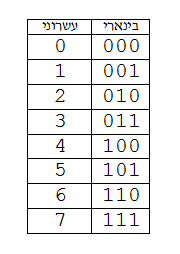
Binary number
System that represents numeric values using two symbols; 0 or 1
Nº Q3913 ★★★★
Not listed