

Uncommon · Places
Ammer (Neckar)
River in Germany
The Ammer (German pronunciation: [ˈamɐ] ) is a small river in Baden-Württemberg, Germany, a tributary of the Neckar. It has its source southwest of Herrenberg.
Read more
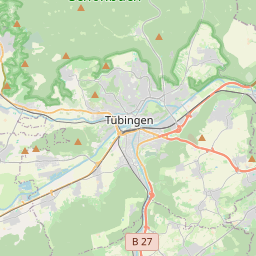
Along the southern edge of the Schönbuch, it flows through Herrenberg, Ammerbuch, Unterjesingen and Tübingen, before it discharges into the Neckar at Tübingen-Lustnau after 22.6 kilometres (14.0 mi). Origin of the Ammer are Ammer springs in the upper valley five spring pots southwest of Herrenberg in the district of Böblingen. From there the Ammer flows through the valley named after it at the southern edge of the Schönbuch nature park as well as the communities Gültstein and Ammerbuch, uniting in Tübingen with the Goldersbach and flows a little later in the Tübingen district Lustnau from the left into the upper Neckar. On its way of 22,5 km the Ammer falls about 94 meters. The Ammer river crosses the villages Gültstein (Herrenberg), Altingen, Reusten, Poltringen, Pfäffingen (all Ammerbuch), Unterjesingen (Tübingen), the hamlet Ammern (Tübingen) and Tübingen. Just 260 m after the Ammer leaves its main spring, the year-round Aischbach flows to it from the left, which has already flowed for more than four kilometres and usually carries more water than the Ammer. Hydrologically speaking, it is therefore the main source arm of the Ammer. The Aischbach is water-bearing all year round from the time it passes under the embankment of the Stuttgart–Horb railway near Herrenberg station.
On the map
Text: Wikipédia, CC BY-SA 4.0. · Image: Tom188 at de.wikipedia (CC BY-SA 3.0) ·