

Common · Nature
Ancyromonadida
Group of protists
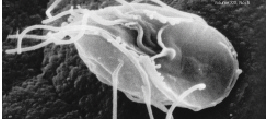
Ancyromonadida or Planomonadida is a small group of biflagellated eukaryotes found in the soil and in aquatic habitats, where they feed on bacteria. They are freshwater or marine organisms, benthic, dorsoventrally compressed and with two unequal flagellae, each emerging from a separate pocket.
From Wikipedia
Ancyromonadida or Planomonadida is a small group of biflagellated eukaryotes found in the soil and in aquatic habitats, where they feed on bacteria. They are freshwater or marine organisms, benthic, dorsoventrally compressed and with two unequal flagellae, each emerging from a separate pocket. The apical anterior flagellum can be very thin or end in the cell membrane, while the posterior flagellum is long and is inserted ventrally or laterally. The cell membrane is supported by a thin single-layered theca and the mitochondrial crests are discoidal/flat. The group's placement is doubtful, as it seems to fall outside the five supergroups of eukaryotes. Cavalier-Smith considers that they constitute a basal group to Amoebozoa and Opisthokonta and places it together with other related groups in Sulcozoa. However, they appear more basal than Malawimonas, placing them in Loukozoa, possibly as stem podiates, and depending on the placement of the root position of the eukaryotes.
Text: Wikipédia, CC BY-SA 4.0. · Image: Maulucioni & Doridí (CC BY-SA 4.0) ·
Related cards
-
 ★
★
Apusomonadida
Order of micro-organisms
-
 ★★★
★★★
Dinoflagellate
Phylum of Alveolata
-
 ★
★
Metamonad
Phylum of excavate protists
-
 ★★
★★
Choanozoa
Clade of eukaryotic organisms (Eukaryota) consisting of the animals (Animalia) and the choanoflagellates (Choanoflagellata)
-
 ★★
★★
Labyrinthulomycetes
Class of protists
-
 ★★
★★
Flagellate
Class of protozoa