

Uncommon · Places
Arta, Greece
City in Epirus, Greece
Arta (Greek: Άρτα) is a city in northwestern Greece and the capital of the regional unit of Arta, in the region of Epirus. The city was known in antiquity as Ambracia (Ancient Greek: Ἀμβρακία) and had served as the capital of ancient Epirus.
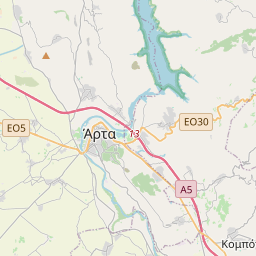
On the map
From Wikipedia
Arta (Greek: Άρτα) is a city in northwestern Greece and the capital of the regional unit of Arta, in the region of Epirus. The city was known in antiquity as Ambracia (Ancient Greek: Ἀμβρακία) and had served as the capital of ancient Epirus. Arta is known for its medieval bridge over the Arachthos River, as well as for its ancient sites from the era of Pyrrhus of Epirus and its well-preserved 13th-century castle. Arta's Byzantine history is reflected in its many Byzantine churches; perhaps the best known is the Panagia Paregoretissa (Mother of God the Consoling), built in about 1290 by Despot Nikephoros I Komnenos Doukas. The origin of the city's name is quite uncertain. It is either derived from a corruption of the river Arachthos, or from the Latin word "artus" (narrow), or from the Slavic word "balta" (swamp). The first settlement in the area of the modern city dates to the 9th century BC. Ambracia was founded as a colony of Corinth in the 7th century BC. In 294 BC, after 43 years of semi-autonomy under Macedonian suzerainty, Ambracia was given to Pyrrhus, king of the Molossians and of Epirus, who made it his capital, using Ambracia as a base to attack the Romans. Pyrrhus managed to achieve great but costly victories against the Romans, hence the phrase "Pyrrhic victory" which refers in particular to an exchange at the Battle of Asculum.
Text: Wikipédia, CC BY-SA 4.0. · Image: Flickr user [2] (Γιάννης Χουβαρδάς). Uploaded from wikimedia... (CC BY-SA 2.0) ·