

Common · Knowledge
Blasius boundary layer
Two-dimensional laminar boundary layer that forms on a semi-infinite plate
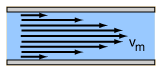
In physics and fluid mechanics, a Blasius boundary layer (named after Paul Richard Heinrich Blasius) describes the steady two-dimensional laminar boundary layer that forms on a semi-infinite plate which is held parallel to a constant unidirectional flow. Falkner and Skan later generalized Blasius' solution to wedge flow (Falkner–Skan boundary layer), i.e. flows in which the plate is not parallel to the flow.
From Wikipedia
In physics and fluid mechanics, a Blasius boundary layer (named after Paul Richard Heinrich Blasius) describes the steady two-dimensional laminar boundary layer that forms on a semi-infinite plate which is held parallel to a constant unidirectional flow. Falkner and Skan later generalized Blasius' solution to wedge flow (Falkner–Skan boundary layer), i.e. flows in which the plate is not parallel to the flow.
Text: Wikipédia, CC BY-SA 4.0. · Image: Onaraighl (talk) (Uploads) (Public domain) ·
Related cards
-
V★
Vlasov equation
Partial differential equation describing the time evolution of plasma
-
 ★★★
★★★
Laminar flow
Flow where fluid particles follow smooth paths in layers
-
 ★★★
★★★
Boltzmann equation
Equation of statistical mechanics
-
M★
Mathieu function
Solutions to Mathieu's differential equations, which are second order linear differential equation
-
 ★
★
Lami's theorem
Equation relating the magnitudes of three coplanar, concurrent and non-collinear vectors, which keeps an object in static equilibrium, with the angles directly opposite to the corresponding vectors
-
B★
Bohr–Van Leeuwen theorem
Theorem