

Bounded variation
Real function with finite total variation
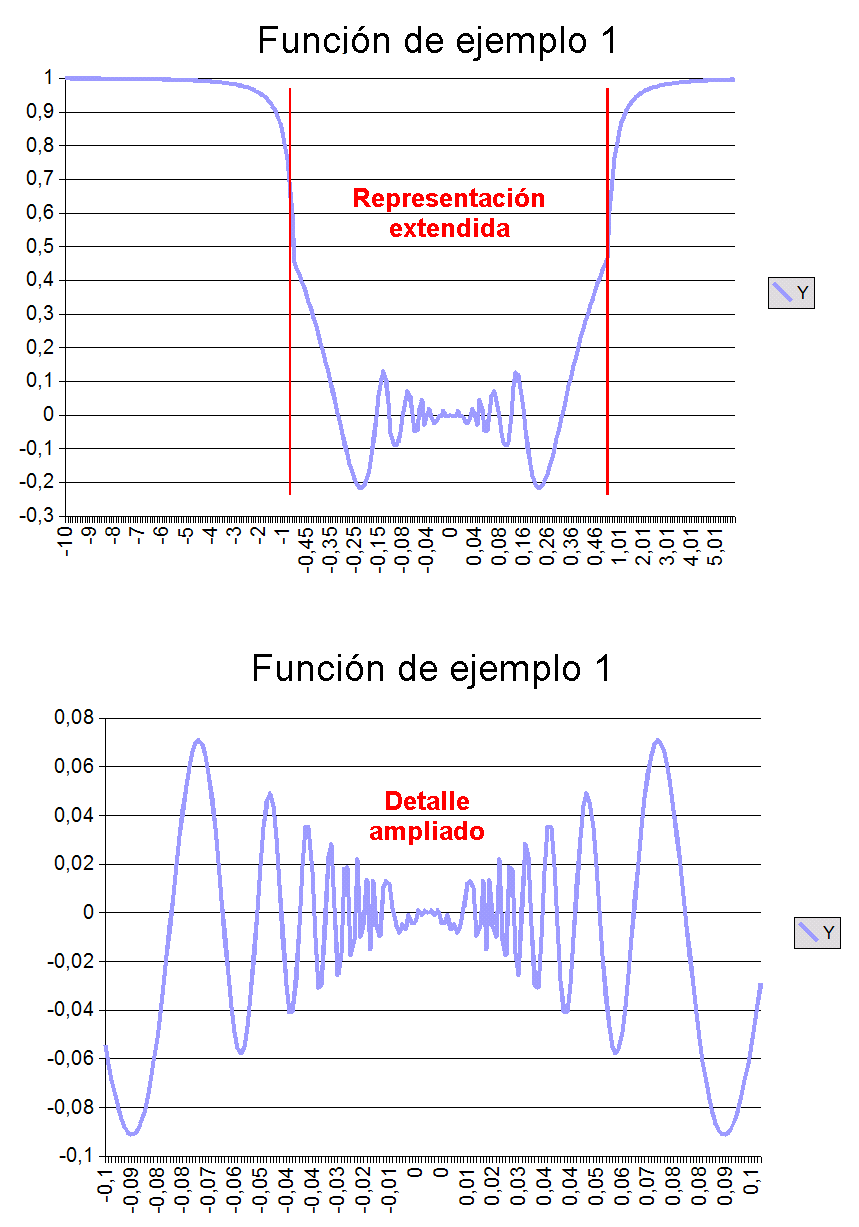
In mathematical analysis, a function of bounded variation, also known as BV function, is a real-valued function whose total variation is bounded (finite): the graph of a function having this property is well behaved in a precise sense. For a continuous function of a single variable, being of bounded variation means that the distance along the direction of the y-axis, neglecting the contribution of motion along x-axis, traveled by a point moving along the graph has a finite value.
Nº Q829653 ★
Common · Knowledge
Bounded variation
Real function with finite total variation
In mathematical analysis, a function of bounded variation, also known as BV function, is a real-valued function whose total variation is bounded (finite): the graph of a function having this property is well behaved in a precise sense. For a continuous function of a single variable, being of bounded variation means that the distance along the direction of the y-axis, neglecting the contribution of motion along x-axis, traveled by a point moving along the graph has a finite value.
From Wikipedia
In mathematical analysis, a function of bounded variation, also known as BV function, is a real-valued function whose total variation is bounded (finite): the graph of a function having this property is well behaved in a precise sense. For a continuous function of a single variable, being of bounded variation means that the distance along the direction of the y-axis, neglecting the contribution of motion along x-axis, traveled by a point moving along the graph has a finite value. For a continuous function of several variables, the meaning of the definition is the same, except for the fact that the continuous path to be considered cannot be the whole graph of the given function (which is a hypersurface in this case), but can be every intersection of the graph itself with a hyperplane (in the case of functions of two variables, a plane) parallel to a fixed x-axis and to the y-axis. A function g {\textstyle g} has bounded variation if and only if the Riemann–Stieltjes integral ∫ a b f d g {\textstyle \int _{a}^{b}f\,dg} exists for every continuous function f {\textstyle f} . Another characterization states that the functions of bounded variation on a compact interval are exactly those f which can be written as a difference g − h, where both g and h are bounded monotone. In particular, a BV function may have discontinuities, but at most countably many. In the case of several variables, a function f defined on an open subset Ω of R n {\displaystyle \mathbb {R} ^{n}} is said to have bounded variation if its distributional derivative is a vector-valued finite Radon measure. One of the most important aspects of functions of bounded variation is that they form an algebra of discontinuous functions whose first derivative exists almost everywhere: due to this...
Text: Wikipédia, CC BY-SA 4.0. · Image: Rainer Bielefeld at German Wikipedia // Wiki LIC (Spanish tr... (Public domain) ·
Related cards
-
R
Rvachev function
Real-valued mathematical function
Nº Q4047790 ★
Not listed
-
F
Functional derivative
Concept in calculus of variation
Nº Q2621220 ★
Not listed
-

Continuous function
Function such that the preimage of an open set is open
Nº Q170058 ★★★
Not listed
-

Total variation distance of probability measures
Distance measure for probability distributions
Nº Q7828155 ★
Not listed
-
R
Real-valued continuous functions
Continuous function whose domain and range are a subset of the real numbers
Nº Q176977 ★★★
Not listed
-

Convolution
Binary mathematical operation on functions, defined as the integral of the product of two functions after one is reflected about the y-axis and shifted, evaluated for all values of shift, producing the convolution function
Nº Q210857 ★★★
Not listed