


Clausius theorem
Theorem that for a thermodynamic system undergoing a thermodynamic cycle, the following inequality holds: ∮ δ𝑄/𝑇 ≤ 0, where δ𝑄 is heat absorbed by the system and 𝑇 is the temperature
The Clausius theorem, also known as the Clausius inequality, states that for a thermodynamic system (e.g. heat engine or heat pump) exchanging heat with external thermal reservoirs and undergoing a thermodynamic cycle, the following inequality holds. − ∮ d S Res = ∮ δ Q T surr ≤ 0 , {\displaystyle -\oint dS_{\text{Res}}=\oint {\frac {\delta Q}{T_{\text{surr}}}}\leq 0,} where ∮ d S Res {\displaystyle \oint dS_{\text{Res}}} is the total entropy change in the external thermal reservoirs (surroundings), δ Q {\displaystyle \delta Q} is an infinitesi...
Nº Q2428364 ★★
Uncommon · Knowledge
Clausius theorem
Theorem that for a thermodynamic system undergoing a thermodynamic cycle, the following inequality holds: ∮ δ𝑄/𝑇 ≤ 0, where δ𝑄 is heat absorbed by the system and 𝑇 is the temperature
The Clausius theorem, also known as the Clausius inequality, states that for a thermodynamic system (e.g. heat engine or heat pump) exchanging heat with external thermal reservoirs and undergoing a thermodynamic cycle, the following inequality holds. − ∮ d S Res = ∮ δ Q T surr ≤ 0 , {\displaystyle -\oint dS_{\text{Res}}=\oint {\frac {\delta Q}{T_{\text{surr}}}}\leq 0,} where ∮ d S Res {\displaystyle \oint dS_{\text{Res}}} is the total entropy change in the external thermal reservoirs (surroundings), δ Q {\displaystyle \delta Q} is an infinitesi...
From Wikipedia
The Clausius theorem, also known as the Clausius inequality, states that for a thermodynamic system (e.g. heat engine or heat pump) exchanging heat with external thermal reservoirs and undergoing a thermodynamic cycle, the following inequality holds. − ∮ d S Res = ∮ δ Q T surr ≤ 0 , {\displaystyle -\oint dS_{\text{Res}}=\oint {\frac {\delta Q}{T_{\text{surr}}}}\leq 0,} where ∮ d S Res {\displaystyle \oint dS_{\text{Res}}} is the total entropy change in the external thermal reservoirs (surroundings), δ Q {\displaystyle \delta Q} is an infinitesimal amount of heat that is taken from the reservoirs and absorbed by the system ( δ Q > 0 {\displaystyle \delta Q>0} if heat from the reservoirs is absorbed by the system, and δ Q {\displaystyle \delta Q} < 0 if heat is leaving from the system to the reservoirs) and T surr {\displaystyle T_{\text{surr}}} is the common temperature of the reservoirs at a particular instant in time. The closed integral is carried out along a thermodynamic process path from the initial/final state to the same initial/final state (thermodynamic cycle). In principle, the closed integral can start and end at an arbitrary point along the path. The Clausius theorem or inequality implies ∮ d S Res ≥ 0 {\displaystyle \oint dS_{\text{Res}}\geq 0} per thermodynamic cycle, meaning that the entropy of the reservoirs increases or does not change, and never decreases, per cycle. For multiple thermal reservoirs with different temperatures ( T 1 , T 2 , … , T N ) {\displaystyle \left(T_{1},T_{2},\dots ,T_{N}\right)} interacting a thermodynamic system undergoing a thermodynamic cycle, the Clausius inequality can be written as the following for expression clarity: − ∮ d S Res = ∮ ( ∑ n = 1 N δ Q n T n ) ≤ 0. {\displaystyle -\oint dS_{\text{Res}}=\oint \left(\sum _{n=1}^{N}{\frac {\delta Q_{n}}{T_{n}}}\right)\leq 0.} where δ Q...
Text: Wikipédia, CC BY-SA 4.0. · Image: Eric Gaba (Sting - fr:Sting) (Public domain) ·
Related cards
-
C
Clausius–Duhem inequality
Thermodynamic law expression
Nº Q5129547 ★
Not listed
-

Gibbs–Duhem equation
Relationship between changes in chemical potential for components in thermodynamic system
Nº Q899155 ★
Not listed
-

Enthalpy–entropy chart
Chart describing internal energy of thermodynamic systems
Nº Q312159 ★★★
Not listed
-
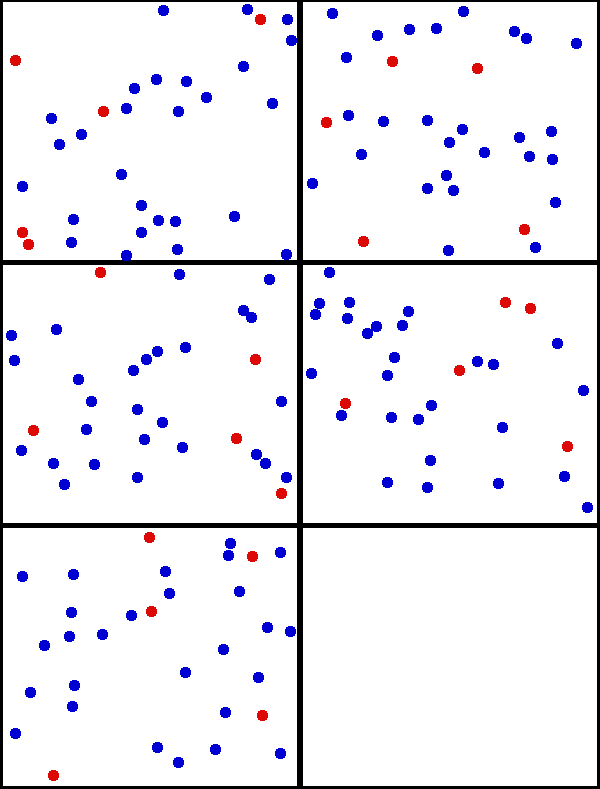
H-theorem
Theorem stating that a quantity H (meant to represent entropy) increases monotonically with time, given an initial condition called molecular chaos (thus breaking time reversal symmetry)
Nº Q899853 ★
Not listed
-
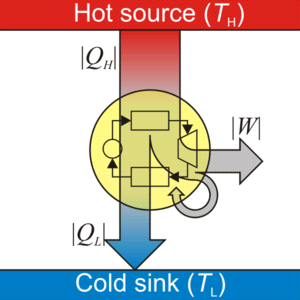
Thermodynamics
Branch of physics concerned with heat, work, temperature, and thermal or internal energy
Nº Q11473 ★★★★
Not listed
-

Fundamental thermodynamic relation
Equations on thermodynamic quantities
Nº Q1474109 ★
Not listed