


DPLL algorithm
Algorithm for solving the CNF-SAT problem
In logic and computer science, the Davis–Putnam–Logemann–Loveland (DPLL) algorithm is a complete, backtracking-based search algorithm for deciding the satisfiability of propositional logic formulae in conjunctive normal form, i.e. for solving the CNF-SAT problem. It was introduced in 1961 by Martin Davis, George Logemann and Donald W. Loveland and is a refinement of the earlier Davis–Putnam algorithm, which is a resolution-based procedure developed by Davis and Hilary Putnam in 1960.
Nº Q2030088 ★★
Uncommon · History
DPLL algorithm
Algorithm for solving the CNF-SAT problem
In logic and computer science, the Davis–Putnam–Logemann–Loveland (DPLL) algorithm is a complete, backtracking-based search algorithm for deciding the satisfiability of propositional logic formulae in conjunctive normal form, i.e. for solving the CNF-SAT problem. It was introduced in 1961 by Martin Davis, George Logemann and Donald W. Loveland and is a refinement of the earlier Davis–Putnam algorithm, which is a resolution-based procedure developed by Davis and Hilary Putnam in 1960.
From Wikipedia
In logic and computer science, the Davis–Putnam–Logemann–Loveland (DPLL) algorithm is a complete, backtracking-based search algorithm for deciding the satisfiability of propositional logic formulae in conjunctive normal form, i.e. for solving the CNF-SAT problem. It was introduced in 1961 by Martin Davis, George Logemann and Donald W. Loveland and is a refinement of the earlier Davis–Putnam algorithm, which is a resolution-based procedure developed by Davis and Hilary Putnam in 1960. Especially in older publications, the Davis–Logemann–Loveland algorithm is often referred to as the "Davis–Putnam method" or the "DP algorithm". Other common names that maintain the distinction are DLL and DPLL.
Text: Wikipédia, CC BY-SA 4.0. · Image: No machine-readable author provided. Tizio assumed (based on... (Public domain) ·
Related cards
-

Shellsort
In-place comparison sorting algorithm invented by D. Shell
Nº Q848955 ★★
Not listed
-

Dynamic programming
Problem optimization method that simplifies a complicated problem by decomposing it into simpler subproblems recursively
Nº Q380679 ★★★
Not listed
-
E
Entscheidungsproblem
In computer science, the impossible task of algorithmically determining whether a given statement is provable from the axioms
Nº Q11030584 ★★
Not listed
-
Bogosort
Highly ineffective sorting algorithm that successively generates permutations of its input until it finds one that is sorted
Nº Q762850 ★★★
Not listed
-

Larry Wall
American computer programmer and author
Nº Q92597 ★★
Not listed
-

Wolfram Research
American software company
Nº Q1367937 ★★
Not listed
-

Peirce's law
Axiom used in logic and philosophy
Nº Q2387196 ★
Not listed
-

Dan Ingalls
American computer scientist
Nº Q92772 ★★
Not listed
-

Manindra Agrawal
Indian computer scientist
Nº Q93029 ★★
Not listed
-
L
Logarithmic derivative
Ratio of a function's derivative to the function; d(ln|f(x)|)/dx
Nº Q762521 ★
Not listed
-
T
TPK algorithm
Program to compare computer programming languages
Nº Q7831057 ★★
Not listed
-

Edsger W. Dijkstra
Dutch computer scientist (1930–2002)
Nº Q8556 ★★★
Not listed
-

RANDU
Pseudorandom number generator
Nº Q1067478 ★
Not listed
-
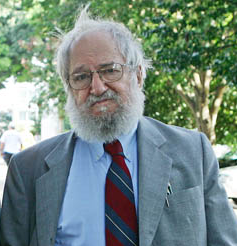
Seymour Papert
MIT mathematician, computer scientist, and educator (1928–2016)
Nº Q335027 ★★
Not listed
-
R
Runge–Kutta–Fehlberg method
Numerical algorithm for the solution of ordinary differential equations
Nº Q7379856 ★
Not listed
-
D
De Casteljau's algorithm
Recursive method to evaluate polynomials in Bernstein form, used to work with Bézier curves
Nº Q1179419 ★
Not listed
-

Lambda calculus
Formal system in mathematical logic
Nº Q242028 ★★★
Not listed
-

Floyd–Steinberg dithering
Image dithering algorithm
Nº Q1324107 ★
Not listed