

Common · Knowledge
Ehrenfest model
Model of diffusion
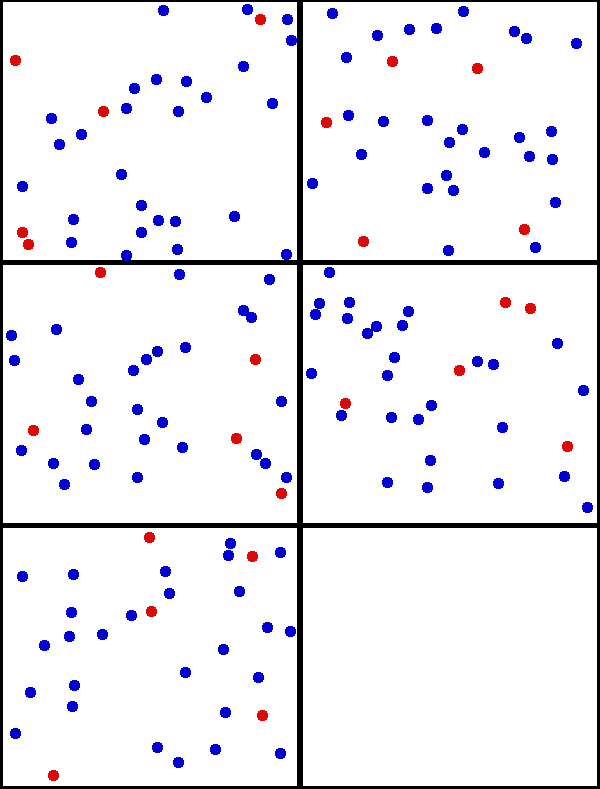
The Ehrenfest model (or dog–flea model) of diffusion was proposed by Tatiana and Paul Ehrenfest in 1907 to explain the second law of thermodynamics. The model considers N particles in two containers. Particles independently change container at a rate λ.
From Wikipedia
The Ehrenfest model (or dog–flea model) of diffusion was proposed by Tatiana and Paul Ehrenfest in 1907 to explain the second law of thermodynamics. The model considers N particles in two containers. Particles independently change container at a rate λ. If X(t) = i is defined to be the number of particles in one container at time t, then it is a birth–death process with transition rates q i , i − 1 = i λ {\displaystyle q_{i,i-1}=i\,\lambda } for i = 1, 2, ..., N q i , i + 1 = ( N − i ) λ {\displaystyle q_{i,i+1}=(N-i\,)\lambda } for i = 0, 1, ..., N – 1 and equilibrium distribution π i = 2 − N ( N i ) {\displaystyle \pi _{i}=2^{-N}{\tbinom {N}{i}}} . Mark Kac proved in 1947 that if the initial system state is not equilibrium, then the entropy, given by H ( t ) = − ∑ i P ( X ( t ) = i ) log ( P ( X ( t ) = i ) π i ) , {\displaystyle H(t)=-\sum _{i}P(X(t)=i)\log \left({\frac {P(X(t)=i)}{\pi _{i}}}\right),} is monotonically increasing (H-theorem). This is a consequence of the convergence to the equilibrium distribution.
Text: Wikipédia, CC BY-SA 4.0. ·
Related cards
-
 ★★
★★
Ehrenfest theorem
Theorem that the time evolution of the expectation value of a quantum observable is proportional to that of the commutator between the observable and the Hamiltonian (plus that of any explicit time dependence of the operator, if any)
-
 ★
★
Gibbs–Duhem equation
Relationship between changes in chemical potential for components in thermodynamic system
-
 ★
★
Maxwell–Stefan diffusion
Model for describing diffusion
-
 ★★
★★
Euler equations (fluid dynamics)
Set of quasilinear hyperbolic equations governing adiabatic and inviscid flow
-
 ★
★
Hubbard model
In solid-state physics, a quantum lattice model of fermions with nearest-neighbor interactinos that describes the conductor-insulator transition
-
 ★
★
H-theorem
Theorem stating that a quantity H (meant to represent entropy) increases monotonically with time, given an initial condition called molecular chaos (thus breaking time reversal symmetry)