

Common · History
Internal conversion
Radioactive decay process wherein an excited nucleus interacts electromagnetically with one of its electrons, causing it to be ejected from the atom
Internal conversion (often abbreviated IC) is an atomic decay process where an excited nucleus interacts electromagnetically with one of the orbital electrons of an atom. This causes the electron to be emitted (ejected) from the atom.
From Wikipedia
Internal conversion (often abbreviated IC) is an atomic decay process where an excited nucleus interacts electromagnetically with one of the orbital electrons of an atom. This causes the electron to be emitted (ejected) from the atom. Thus, in internal conversion, a high-energy electron is emitted from the excited atom, but not from the nucleus. For this reason, the high-speed electrons resulting from internal conversion are not called beta particles, since the latter come from beta decay, where they are newly created in the nuclear decay process. IC is possible whenever gamma decay is possible, except if the atom is fully ionized. In IC, the atomic number does not change, and thus there is no transmutation of one element to another. Also, neutrinos and the weak force are not involved in IC. Since an electron is lost from the atom, a hole appears in an electron aura which is subsequently filled by other electrons that descend to the empty, yet lower energy level, and in the process emit characteristic X-ray(s), Auger electron(s), or both. The atom thus emits high-energy electrons and X-ray photons, none of which originate in that nucleus. The atom supplies the energy needed to eject the electron, which in turn causes the latter events and the other emissions. Since primary electrons from IC carry a fixed (large) part of the characteristic decay energy, they have a discrete energy spectrum, rather than the spread (continuous) spectrum characteristic of beta particles. Whereas the energy spectrum of beta particles plots as a broad hump, the energy spectrum of internally converted electrons plots as a single sharp peak (see example below).
Text: Wikipédia, CC BY-SA 4.0. · Image: Kjerish (CC BY-SA 4.0) ·
Related cards
-
 ★★
★★
Electron capture
Process in which a proton-rich nuclide absorbs an inner atomic electron
-
 ★
★
Positron emission
Radioactive decay in which a proton is converted into a neutron while releasing a positron and a neutrino
-
 ★★★★
★★★★
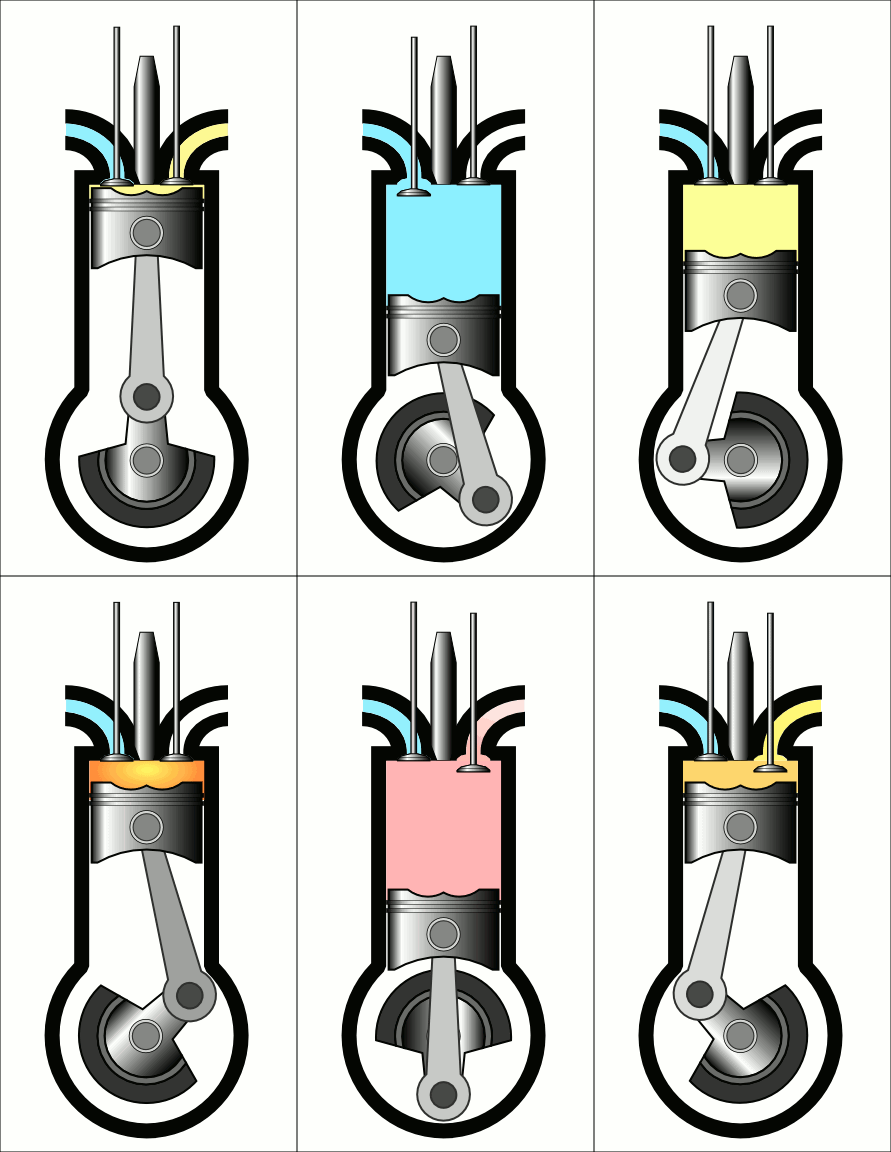
Internal combustion engine
Engine in which the combustion of a fuel occurs with an oxidizer in a combustion chamber
-
b★★
beta minus decay
Beta decay where the atomic number increases and an electron is emitted
-
 ★★★
★★★
Alpha decay
Emission of alpha particles by a decaying radioactive atom
-
 ★★★★
★★★★
Ionizing radiation
Radiation that carries enough energy to liberate electrons from atoms or molecules