

Uncommon · Places
Karfi
Human settlement
Karfi (also Karphi, Greek: Καρφί) is an archaeological site high up in the Dikti Mountains in eastern Crete, Greece. The ancient name of the site is unknown; "Karfi" ("the nail") is a local toponym for the prominent knob of limestone that marks the peak of the site, especially when viewed from the north.
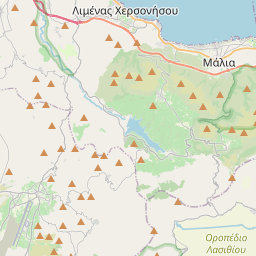
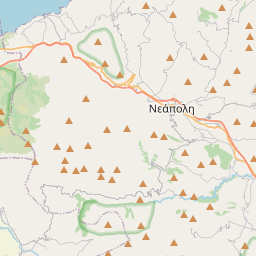
On the map
From Wikipedia
35°13′04″N 25°28′12″E / 35.217798°N 25.470130°E / 35.217798; 25.470130 (Karfi) Karfi (also Karphi, Greek: Καρφί) is an archaeological site high up in the Dikti Mountains in eastern Crete, Greece. The ancient name of the site is unknown; "Karfi" ("the nail") is a local toponym for the prominent knob of limestone that marks the peak of the site, especially when viewed from the north. Located approximately 1100 meters above sea level, and overlooking the northern entrance to the Lasithi Plateau, the dramatic situation of Karfi is somewhat akin to that of the famous Inca site of Machu Picchu in Peru. While there is some evidence that the site was used during the Middle Minoan period as a peak sanctuary, Karfi is best known as a large and extensively excavated town of the Late Minoan IIIC period (around 1200–1000 BCE) at the beginning of the Greek "Dark Ages." The peak of Karfi was originally a peak sanctuary, occupying a typical site on a high shoulder (some 1.1 km (3,600 ft) above sea level) with a wide "viewshed" (Soetens, Driessen et al.) that connected it with sightlines to other sites, typical of the network developed in the "first Palace period" (Middle Minoan IB–II, 1900–1800 BCE) onwards, but probably abandoned, perhaps under increased religious centralization, in Middle Minoan IIIA (ca 1650 BCE) (Soetens, Driesen et al.). The rocky site is dominated by a bifurcated stone outcropping that is unmistakably like the carved and shaped crescent horn stone altars known in Crete and Cyprus. When the warlike mixed group conventionally referred to as Dorians arrived on Crete from the Peloponnese after ca 1100 BCE, archaeological reconstructions suggest that they would have found the Minoan people living along with the Mycenaeans, surviving as an underclass. No doubt the Minoan language continued to be spoken by the peasants, though inscriptions, now in Linear B, were all in a form of Greek associated with a Mycenaean upper class (BBC). The Dorians seem to have driven the local people up into the hills; the latest towns with Minoan material culture are in more and more inaccessible places, one of the largest and most extensive settlements being at Karfi, high in the Dikti Mountains. At this high, remote, ancient, and sacred site a fragment of Minoan civilization survived intact for about 400 years after the occupation of Knossos.
Text: Wikipédia, CC BY-SA 4.0. · Image: Schuppi (CC BY-SA 3.0) ·