

Common · Knowledge
Kleene's recursion theorem
Theorem in computability theory
In computability theory, Kleene's recursion theorems are a pair of fundamental results about the application of computable functions to their own descriptions. The theorems were first proved by Stephen Kleene in 1938 and appear in his 1952 book Introduction to Metamathematics.
From Wikipedia
In computability theory, Kleene's recursion theorems are a pair of fundamental results about the application of computable functions to their own descriptions. The theorems were first proved by Stephen Kleene in 1938 and appear in his 1952 book Introduction to Metamathematics. A related theorem, which constructs fixed points of a computable function, is known as Rogers's theorem and is due to Hartley Rogers, Jr. The recursion theorems can be applied to construct fixed points of certain operations on computable functions, to generate quines, and to construct functions defined via recursive definitions.
Text: Wikipédia, CC BY-SA 4.0. ·
Related cards
-
 ★
★
Stephen Cole Kleene
American mathematician and theoretical computer scientist (1909–1994)
-
 ★★
★★
Ackermann function
Total non-primitive-recursive computable function
-
 ★
★
Arithmetical hierarchy
Hierarchy which classifies certain sets based on the complexity of formulas that define them
-
L★
Lefschetz fixed-point theorem
Theorem
-
 ★
★
Kakutani fixed-point theorem
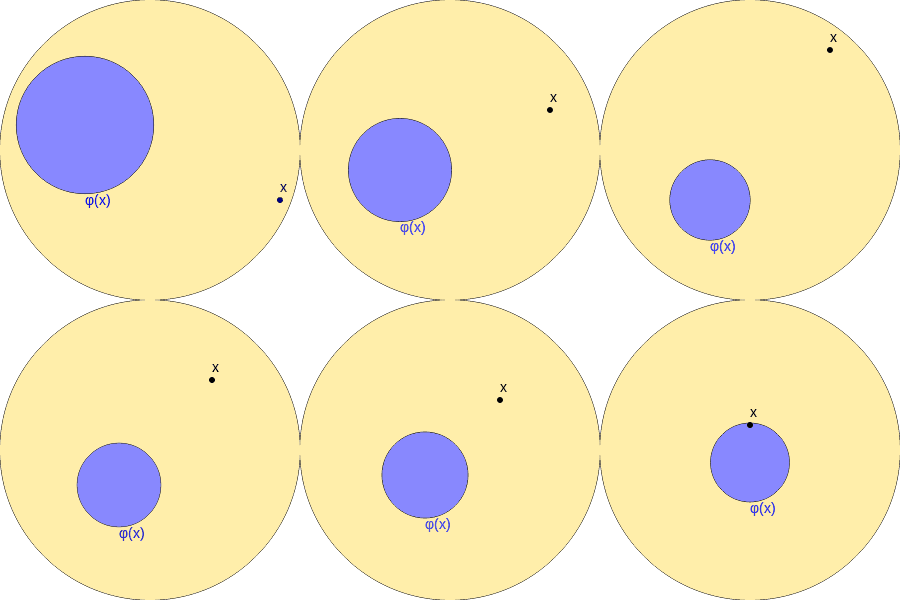
Theorem that a function f: S→Pow(S) on a compact nonempty convex subset S⊂ℝⁿ, whose graph is closed and whose image f(x) is nonempty and convex for all x∈S, has a fixed point
-
 ★★
★★
Brouwer fixed-point theorem
Every continuous function on a compact set has a fixed point