

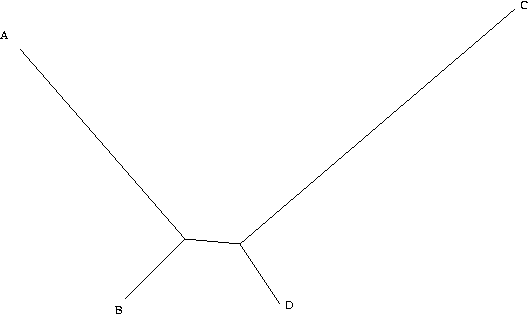
Maximum parsimony
Optimality criterion under which the phylogenetic tree that minimizes the total number of character-state changes is to be preferred; under this criterion, the shortest possible tree that explains the data is considered best
In evolutionary biology, maximum parsimony is a method used to build phylogenetic trees based on the principle of simplicity. Under the maximum-parsimony criterion, the best tree will minimize the amount of homoplasy (i.e., convergent evolution, parallel evolution, and evolutionary reversals).
Nº Q1805805 ★
Common · Knowledge
Maximum parsimony
Optimality criterion under which the phylogenetic tree that minimizes the total number of character-state changes is to be preferred; under this criterion, the shortest possible tree that explains the data is considered best
In evolutionary biology, maximum parsimony is a method used to build phylogenetic trees based on the principle of simplicity. Under the maximum-parsimony criterion, the best tree will minimize the amount of homoplasy (i.e., convergent evolution, parallel evolution, and evolutionary reversals).
From Wikipedia
In evolutionary biology, maximum parsimony is a method used to build phylogenetic trees based on the principle of simplicity. Under the maximum-parsimony criterion, the best tree will minimize the amount of homoplasy (i.e., convergent evolution, parallel evolution, and evolutionary reversals). In other words, under this criterion, the optimal tree has the shortest graph using the fewest evolutionary steps required to explain its genetic and physical data. Some of the basic ideas behind maximum parsimony were presented by James S. Farris in 1970 and Walter M. Fitch in 1971. Maximum parsimony is an intuitive and simple criterion, and it is popular for this reason. However, although it is easy to score a phylogenetic tree (by counting the total number of character-state changes), finding the single most-parsimonious tree is computationally difficult because researchers must search amongst all possible configurations. For a small number of taxa (i.e., fewer than nine) it is possible to do an exhaustive search, in which every possible tree is scored, and the best one is selected. For nine to twenty taxa, it will generally be preferable to use branch-and-bound, which is also guaranteed to find the best tree. For over twenty taxa, a heuristic search must be performed. Because the most-parsimonious tree favors the shortest possible evolutionary graph, this means that it will often underestimate the actual evolutionary change that could have occurred. In addition, maximum parsimony is not statistically consistent. As demonstrated in 1978 by Joe Felsenstein, maximum parsimony can be inconsistent under certain conditions, such as long-branch attraction. On the other hand, cladists like Andrew Brower support parsimony, arguing that whether a tree is wrong is fundamentally untestable, unlike the question of whether a tree is the shortest among examined ones.
Text: Wikipédia, CC BY-SA 4.0. · Image: A1kmm at English Wikipedia (Public domain) ·
Related cards
-
p
parsimony
Use of the minimum set of elements required to achieve a goal
Nº Q3364869 ★★★
Not listed
-

Maximum principle
Theorem that a harmonic function’s maximum can only be at the boundary of its domain
Nº Q1914255 ★
Not listed
-
T
Treewidth
Integer invariant of an undirected graph which measures how far it is from being a tree
Nº Q5067368 ★
Not listed
-
P
Pontryagin's maximum principle
Principle in optimal control theory for best way to change state in a dynamical system
Nº Q3491629 ★★
Not listed
-
M
Minimal polynomial (linear algebra)
Minimal polynomial of a matrix
Nº Q1163608 ★
Not listed
-
B
Blossom algorithm
Algorithm for constructing maximum matchings on a graph
Nº Q1030529 ★
Not listed