

Uncommon · Knowledge
Morse potential
Interatomic interaction model
The Morse potential, named after physicist Philip M. Morse, is a convenient interatomic interaction model for the potential energy of a diatomic molecule. It is a better approximation for the vibrational structure of the molecule than the quantum harmonic oscillator because it explicitly includes the effects of bond breaking, such as the existence of unbound states.
From Wikipedia
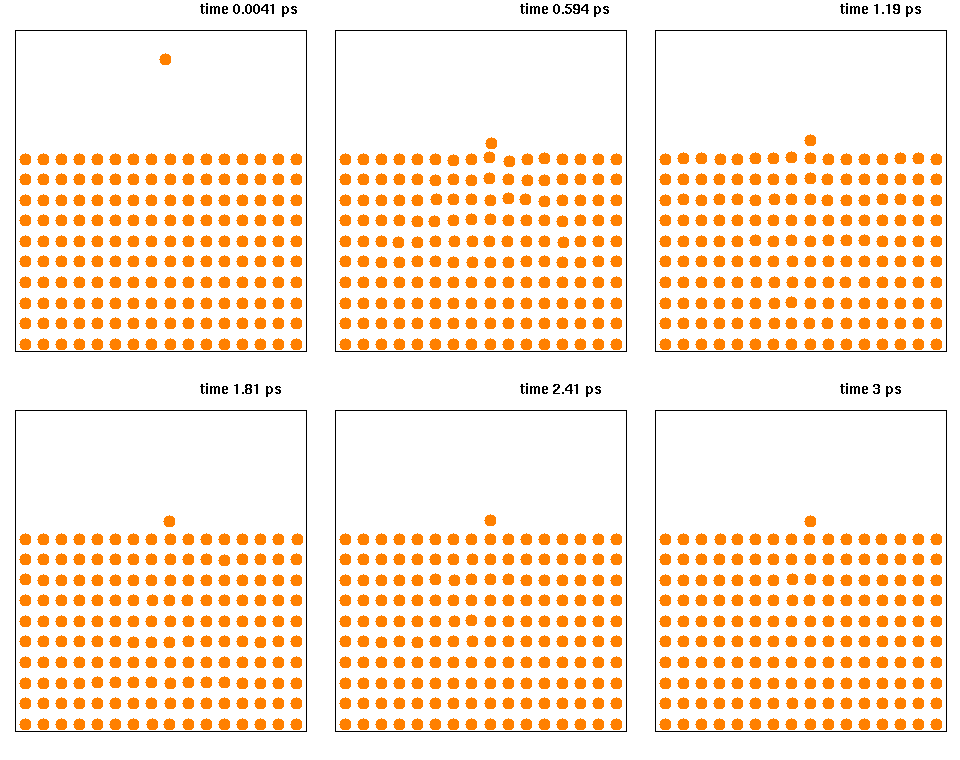
The Morse potential, named after physicist Philip M. Morse, is a convenient interatomic interaction model for the potential energy of a diatomic molecule. It is a better approximation for the vibrational structure of the molecule than the quantum harmonic oscillator because it explicitly includes the effects of bond breaking, such as the existence of unbound states. It also accounts for the anharmonicity of real bonds and the non-zero transition probability for overtone and combination bands. The Morse potential can also be used to model other interactions, such as those between an atom and a surface. Due to its simplicity (only three fitting parameters), it is not used in modern spectroscopy. However, its mathematical form inspired the MLR (Morse/Long-range) potential, the most popular potential energy function for fitting spectroscopic data.
Text: Wikipédia, CC BY-SA 4.0. · Image: Mark Somoza March (CC BY-SA 4.0) ·
Related cards
-
 ★
★
Interatomic potential
Functions for calculating potential energy
-
 ★★
★★
Molecular dynamics
Method of computer simulation of molecular interaction
-
P★
Poisson–Boltzmann equation
Equation describing the distribution of the electric potential in solution in the direction normal to a charged surface
-
 ★
★
Torsion constant
Geometrical property of a bar’s cross-section
-
Q★★
Quintessence (physics)
Dynamic scalar field hypothesized as a form of dark energy
-
P★
Power-law fluid
Physical law