

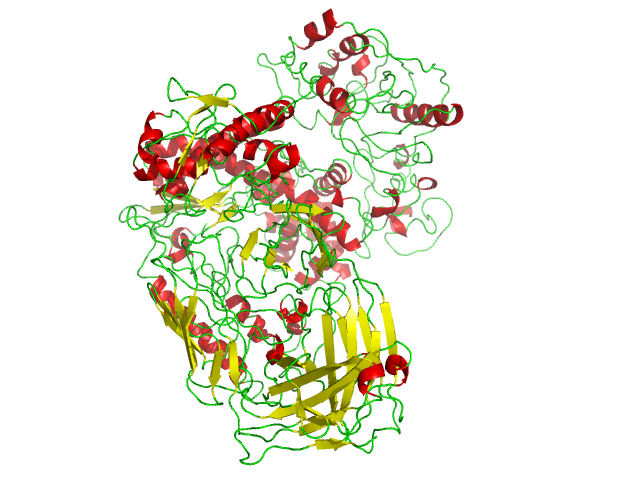
Polymerase
Class of enzymes
In biochemistry, a polymerase is an enzyme (EC 2.7.7.6/7/19/48/49) that synthesizes long chains of polymers or nucleic acids. DNA polymerase and RNA polymerase are used to assemble DNA and RNA molecules, respectively, by copying a DNA template strand using base-pairing interactions or half ladder replication.
Nº Q416878 ★
Common · Knowledge
Polymerase
Class of enzymes
In biochemistry, a polymerase is an enzyme (EC 2.7.7.6/7/19/48/49) that synthesizes long chains of polymers or nucleic acids. DNA polymerase and RNA polymerase are used to assemble DNA and RNA molecules, respectively, by copying a DNA template strand using base-pairing interactions or half ladder replication.
From Wikipedia
In biochemistry, a polymerase is an enzyme (EC 2.7.7.6/7/19/48/49) that synthesizes long chains of polymers or nucleic acids. DNA polymerase and RNA polymerase are used to assemble DNA and RNA molecules, respectively, by copying a DNA template strand using base-pairing interactions or half ladder replication. A DNA polymerase from the thermophilic bacterium, Thermus aquaticus (Taq) (PDB 1BGX Archived 2007-07-04 at the Wayback Machine, EC 2.7.7.7), is used in the polymerase chain reaction, an important technique of molecular biology. A polymerase may be template-dependent or template-independent. Poly-A-polymerase is an example of template independent polymerase. Terminal deoxynucleotidyl transferase is also known to have template independent and template dependent activities.
Text: Wikipédia, CC BY-SA 4.0. · Image: Lijealso (Public domain) ·
Related cards
-

DNA polymerase III holoenzyme
Complex that contains 10 different types of subunits
Nº Q21119136 ★
Not listed
-

DNA polymerase
Enzyme that synthesizes DNA from a nucleic acid template
Nº Q206286 ★★
Not listed
-

RNA polymerase II
DNA-dependent RNA polymerase
Nº Q15334993 ★
Not listed
-

RNA polymerase
Class of enzymes that synthesize RNA from a DNA template
Nº Q272631 ★★
Not listed
-

Primase
Class of enzymes
Nº Q106940703 ★
Not listed
-

RNA
Family of large biological molecules
Nº Q11053 ★★★★
Not listed