


Quantum phase estimation algorithm
Quantum algorithm to estimate the eigenvalue of a unitary operator
In quantum computing, the quantum phase estimation algorithm is a quantum algorithm to estimate the phase corresponding to an eigenvalue of a given unitary operator. Because the eigenvalues of a unitary operator always have unit modulus, they are characterized by their phase, and therefore the algorithm can be equivalently described as retrieving either the phase or the eigenvalue itself.
Nº Q2835770 ★
Common · Knowledge
Quantum phase estimation algorithm
Quantum algorithm to estimate the eigenvalue of a unitary operator
In quantum computing, the quantum phase estimation algorithm is a quantum algorithm to estimate the phase corresponding to an eigenvalue of a given unitary operator. Because the eigenvalues of a unitary operator always have unit modulus, they are characterized by their phase, and therefore the algorithm can be equivalently described as retrieving either the phase or the eigenvalue itself.
From Wikipedia
In quantum computing, the quantum phase estimation algorithm is a quantum algorithm to estimate the phase corresponding to an eigenvalue of a given unitary operator. Because the eigenvalues of a unitary operator always have unit modulus, they are characterized by their phase, and therefore the algorithm can be equivalently described as retrieving either the phase or the eigenvalue itself. The algorithm was initially introduced by Alexei Kitaev in 1995. Phase estimation is frequently used as a subroutine in other quantum algorithms, such as Shor's algorithm, the quantum algorithm for linear systems of equations, and the quantum counting algorithm.
Text: Wikipédia, CC BY-SA 4.0. · Image: Bender2k14 (CC BY-SA 3.0) ·
Related cards
-
W
Wigner–Weyl transform
Mapping between functions in the quantum phase space
Nº Q1431119 ★
Not listed
-
Wigner's theorem
Theorem in the mathematical formulation of quantum mechanics
Nº Q1135224 ★
Not listed
-
Q
QR algorithm
Numerical linear algebra algorithm
Nº Q453132 ★★★
Not listed
-
V
Variational quantum eigensolver
Hybrid algorithm that uses both classical computers and quantum computers to find the ground state of a given physical system
Nº Q113512153 ★
Not listed
-
E
Ensemble interpretation
Interpretation of quantum mechanics that considers the quantum state description to apply only to an ensemble of similarly prepared systems, rather than supposing that it exhaustively represents an individual physical system
Nº Q869255 ★
Not listed
-

Q Sharp
Programming language
Nº Q45322975 ★
Not listed
-
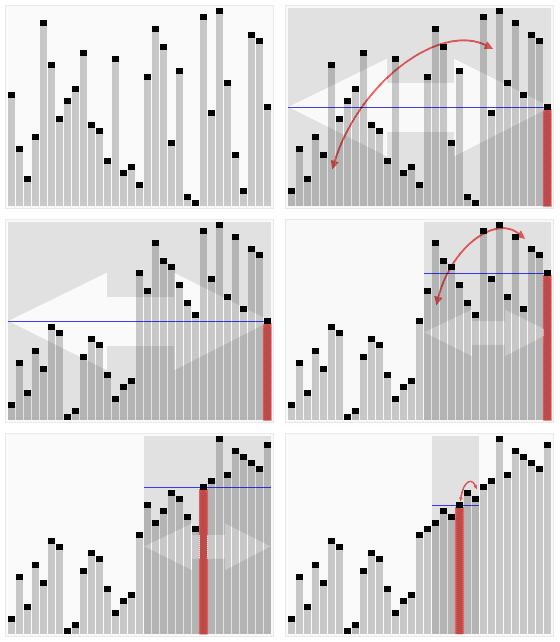
Quickselect
Selection algorithm to find the kth smallest element in an unordered list
Nº Q3927837 ★
Not listed
-
Q
Quantum indeterminacy
Apparent lack of definite state before measurement of quantum systems
Nº Q7269059 ★
Not listed
-

Quine–McCluskey algorithm
Algorithm
Nº Q621409 ★
Not listed
-

Quantile regression
Statistical model
Nº Q3455889 ★★
Not listed
-
Q
Quantum memory
Device for storing quantum information
Nº Q4218489 ★
Not listed
-

Quicksort
Divide and conquer sorting algorithm
Nº Q486598 ★★★★
Not listed
-
Q
Quadratic unconstrained binary optimization
Combinatorial optimization problem
Nº Q7268372 ★
Not listed
-
Q
Q-derivative
Q-analog of the ordinary derivative
Nº Q7265300 ★★
Not listed
-

Quantum cryptography
The science of exploiting quantum mechanical properties to perform cryptographic tasks
Nº Q471906 ★★
Not listed
-

Quantum annealing
Method for finding solutions to combinatorial optimisation problems and ground states of glassy systems using quantum fluctuations
Nº Q938141 ★★
Not listed
-
H
Holevo's theorem
Upper bound on the knowable information of a quantum state
Nº Q3984018 ★
Not listed
-

Quantum information science
Interdisciplinary theory behind quantum computing
Nº Q2122216 ★★
Not listed