

Range coding
Entropy coding method defined by G. Nigel N. Martin in a 1979 paper, which effectively rediscovered the FIFO arithmetic code first introduced by Richard Clark Pasco in 1976
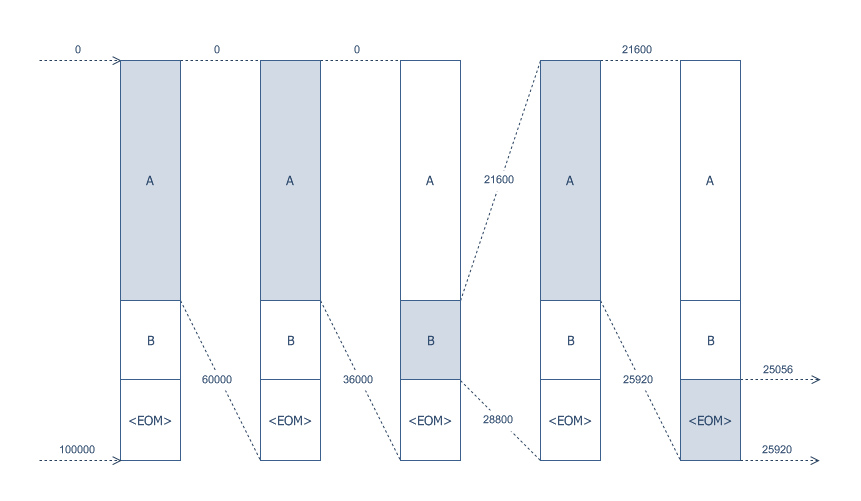
Range coding (or range encoding) is an entropy coding method defined by G. Nigel N. Martin in a 1979 paper, which effectively rediscovered the FIFO arithmetic code first introduced by Richard Clark Pasco in 1976. Given a stream of symbols and their probabilities, a range coder produces a space-efficient stream of bits to represent these symbols and, given the stream and the probabilities, a range decoder reverses the process.
Nº Q818947 ★
Common · History
Range coding
Entropy coding method defined by G. Nigel N. Martin in a 1979 paper, which effectively rediscovered the FIFO arithmetic code first introduced by Richard Clark Pasco in 1976
Range coding (or range encoding) is an entropy coding method defined by G. Nigel N. Martin in a 1979 paper, which effectively rediscovered the FIFO arithmetic code first introduced by Richard Clark Pasco in 1976. Given a stream of symbols and their probabilities, a range coder produces a space-efficient stream of bits to represent these symbols and, given the stream and the probabilities, a range decoder reverses the process.
From Wikipedia
Range coding (or range encoding) is an entropy coding method defined by G. Nigel N. Martin in a 1979 paper, which effectively rediscovered the FIFO arithmetic code first introduced by Richard Clark Pasco in 1976. Given a stream of symbols and their probabilities, a range coder produces a space-efficient stream of bits to represent these symbols and, given the stream and the probabilities, a range decoder reverses the process. Range coding is very similar to arithmetic coding, except that coding is done with digits in any base, instead of with bits, and so it is faster when using larger bases (e.g. a byte) at small cost in compression efficiency. After the expiration of the first (1978) arithmetic coding patent, range coding appeared to clearly be free of patent encumbrances. This particularly drove interest in the technique in the open source community. Since that time, patents on various well-known arithmetic coding techniques have also expired.
Text: Wikipédia, CC BY-SA 4.0. · Image: jasco (talk) (CC BY-SA 3.0) ·
Related cards
-

Binary-coded decimal
Class of binary encodings of decimal numbers where each decimal digit is represented by a fixed number of bits, usually four or eight. Special bit patterns are sometimes used for a sign or for other indications
Nº Q276582 ★★★
Not listed
-
R
RDRAND
Instruction for returning random numbers from an x86-64 architecture on-chip hardware random number generator
Nº Q7299894 ★
Not listed
-
F
Fibonacci coding
Universal code
Nº Q2633 ★★
Not listed
-

Numerical Electromagnetics Code
Computer program for antenna modeling
Nº Q630242 ★
Not listed
-

Phillips Code
Shorthand code
Nº Q7185887 ★
Not listed
-

Binary GCD algorithm
Algorithm that computes the greatest common divisor of two integers using only arithmetic shifts, comparisons, and subtraction
Nº Q622328 ★
Not listed