

Range coding
Entropy coding method defined by G. Nigel N. Martin in a 1979 paper, which effectively rediscovered the FIFO arithmetic code first introduced by Richard Clark Pasco in 1976
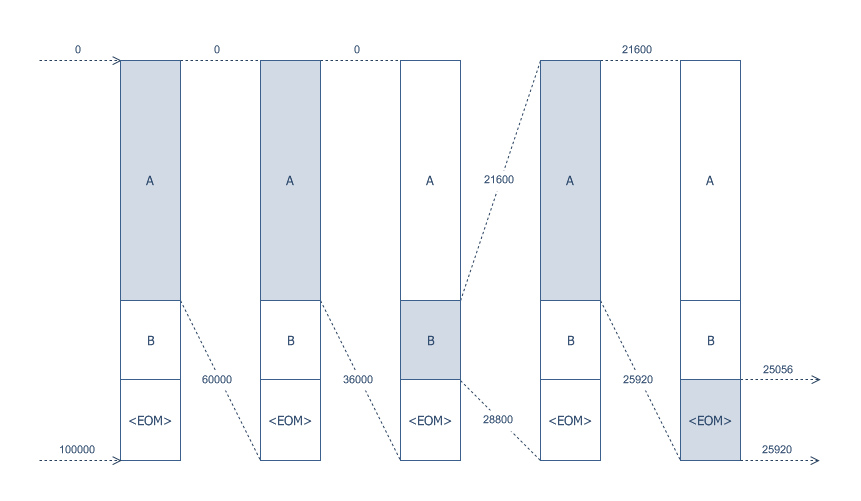
Range coding (or range encoding) is an entropy coding method defined by G. Nigel N. Martin in a 1979 paper, which effectively rediscovered the FIFO arithmetic code first introduced by Richard Clark Pasco in 1976. Given a stream of symbols and their probabilities, a range coder produces a space-efficient stream of bits to represent these symbols and, given the stream and the probabilities, a range decoder reverses the process.
Nº Q818947 ★
Common · History
Range coding
Entropy coding method defined by G. Nigel N. Martin in a 1979 paper, which effectively rediscovered the FIFO arithmetic code first introduced by Richard Clark Pasco in 1976
Range coding (or range encoding) is an entropy coding method defined by G. Nigel N. Martin in a 1979 paper, which effectively rediscovered the FIFO arithmetic code first introduced by Richard Clark Pasco in 1976. Given a stream of symbols and their probabilities, a range coder produces a space-efficient stream of bits to represent these symbols and, given the stream and the probabilities, a range decoder reverses the process.
From Wikipedia
Range coding (or range encoding) is an entropy coding method defined by G. Nigel N. Martin in a 1979 paper, which effectively rediscovered the FIFO arithmetic code first introduced by Richard Clark Pasco in 1976. Given a stream of symbols and their probabilities, a range coder produces a space-efficient stream of bits to represent these symbols and, given the stream and the probabilities, a range decoder reverses the process. Range coding is very similar to arithmetic coding, except that coding is done with digits in any base, instead of with bits, and so it is faster when using larger bases (e.g. a byte) at small cost in compression efficiency. After the expiration of the first (1978) arithmetic coding patent, range coding appeared to clearly be free of patent encumbrances. This particularly drove interest in the technique in the open source community. Since that time, patents on various well-known arithmetic coding techniques have also expired.
Text: Wikipédia, CC BY-SA 4.0. · Image: jasco (talk) (CC BY-SA 3.0) ·
Related cards
-

Simpson's rule
Numerical integration
Nº Q722507 ★★
Not listed
-
H
Hard coding
Software development practice of embedding data into the source code
Nº Q2111125 ★
Not listed
-

Descartes' rule of signs
Theorem
Nº Q1379344 ★
Not listed
-
F
FRACTRAN
Turing-complete esoteric programming language invented by John Conway
Nº Q3063395 ★
Not listed
-

Electronic Product Code
Universal identifier that provides a unique identity for every physical object anywhere in the world, for all time
Nº Q1327374 ★
Not listed
-
V
Vexillological symbol
Ideogram used to indicate certain characteristics of national flags
Nº Q12152721 ★★★★
Not listed
-
P
PL/0
Programming language, intended as an educational programming language, that is similar to but much simpler than Pascal
Nº Q1719128 ★
Not listed
-
C
Consistent Overhead Byte Stuffing
Algorithm for encoding data bytes
Nº Q5163224 ★
Not listed
-

Interval arithmetic
Method for bounding the errors of numerical computations
Nº Q1671453 ★
Not listed
-

PP (complexity)
Complexity class
Nº Q1563053 ★
Not listed
-

FROG
Block cipher
Nº Q3063412 ★
Not listed
-

Halting problem
Problem of determining whether a given program will finish running or continue forever
Nº Q622849 ★★★
Not listed
-

Frequency-hopping spread spectrum
Radio signal transmission method invented by Hedy Lamarr
Nº Q1136013 ★★
Not listed
-

IP (complexity)
Complexity class
Nº Q5973158 ★★
Not listed
-
O
Open Location Code
Encoding of geographic coordinates into a short string of characters and digits, named plus code
Nº Q23582265 ★★
Not listed
-

Nippon Decimal Classification
Library classification system developed for mainly Japanese language books
Nº Q774896 ★★★
Not listed
-

Fast inverse square root
Root-finding algorithm
Nº Q32980 ★★★
Not listed
-
I
IPA number
Identifier for a phoneme in the International Phonetic Alphabet
Nº Q110910334 ★
Not listed