

Common · Knowledge
Rheumatoid factor
Autoantibody directed against the Fc fragment of immunoglobulin G
Rheumatoid factor (RF) is the autoantibody that was first found in rheumatoid arthritis. It is defined as an antibody against the Fc portion of IgG; different RFs can recognize different parts of the IgG-Fc.
From Wikipedia
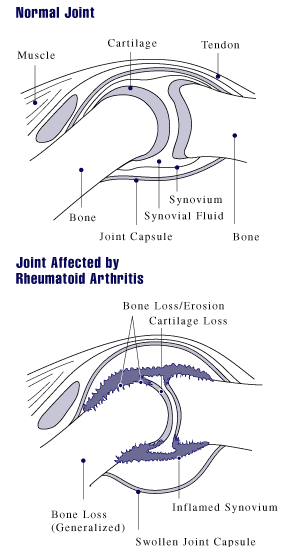
Rheumatoid factor (RF) is the autoantibody that was first found in rheumatoid arthritis. It is defined as an antibody against the Fc portion of IgG; different RFs can recognize different parts of the IgG-Fc. RF and IgG join to form immune complexes that contribute to the disease process such as chronic inflammation and joint destruction at the synovium and cartilage. Rheumatoid factor can also be a cryoglobulin, an antibody that precipitates on cooling of a blood sample. It can either be a type 2 (monoclonal IgM to polyclonal IgG) or type 3 (polyclonal IgM to polyclonal IgG) cryoglobulin. Although predominantly encountered as IgM, rheumatoid factor can be of any isotype of immunoglobulins: IgA, IgG, IgM, IgE, or IgD.
Text: Wikipédia, CC BY-SA 4.0. · Image: Titus322 (CC BY-SA 3.0) ·
Related cards
-
 ★★★★
★★★★
Rh blood group system
Human blood group system
-
 ★
★
Anti-SSA/Ro autoantibodies
Anti-nuclear autoantibodies
-
 ★
★
Gamma globulin
A class of blood proteins
-
 ★★★★
★★★★
Antibody
Immune system protein that binds with an antigen
-
 ★★★★
★★★★
Rheumatoid arthritis
Autoimmune disease which attacks healthy cells and tissue located in joints
-
 ★
★
Hyper IgM syndrome
Primary immune deficiency disorders characterized by defective CD40 signaling