


Richardson extrapolation
A sequence acceleration method, used to improve the rate of convergence
In numerical analysis, Richardson extrapolation is a method used to estimate some value A ∗ = lim h → 0 A ( h ) {\displaystyle A^{\ast }=\lim _{h\to 0}A(h)} if the truncation error is known to have a (possibly 1-sided) power-series expansion at h = 0 {\displaystyle h=0} . The method is most often applied as a sequence acceleration method to improve the rate of convergence of iterative methods.
Nº Q1063089 ★
Common · Knowledge
Richardson extrapolation
A sequence acceleration method, used to improve the rate of convergence
In numerical analysis, Richardson extrapolation is a method used to estimate some value A ∗ = lim h → 0 A ( h ) {\displaystyle A^{\ast }=\lim _{h\to 0}A(h)} if the truncation error is known to have a (possibly 1-sided) power-series expansion at h = 0 {\displaystyle h=0} . The method is most often applied as a sequence acceleration method to improve the rate of convergence of iterative methods.
From Wikipedia
In numerical analysis, Richardson extrapolation is a method used to estimate some value A ∗ = lim h → 0 A ( h ) {\displaystyle A^{\ast }=\lim _{h\to 0}A(h)} if the truncation error is known to have a (possibly 1-sided) power-series expansion at h = 0 {\displaystyle h=0} . The method is most often applied as a sequence acceleration method to improve the rate of convergence of iterative methods. It is named after Lewis Fry Richardson, who introduced the technique in the early 20th century, though a form of the idea was already known to Christiaan Huygens in the 17th century and used his calculation of π {\displaystyle \pi } . Practical applications of Richardson extrapolation include Romberg integration, which applies Richardson extrapolation to the trapezoid rule, and the Bulirsch–Stoer algorithm for solving ordinary differential equations. In the words of Birkhoff and Rota, "its usefulness for practical computations can hardly be overestimated."
Text: Wikipédia, CC BY-SA 4.0. · Image: Francis Bach (CC BY-SA 4.0) ·
Related cards
-
R
Rayleigh–Ritz method
Method for approximating eigenvalues
Nº Q852247 ★
-
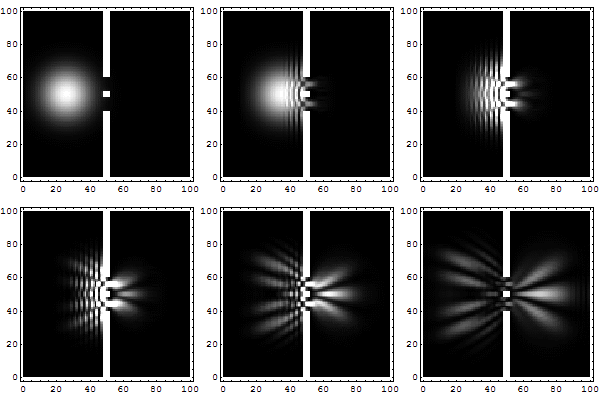
Crank–Nicolson method
Finite difference method for numerically solving parabolic differential equations
Nº Q588725 ★
-

Successive over-relaxation
Method of solving a linear system of equations
Nº Q1561270 ★
-

Inverse distance weighting
Multivariate interpolation algorithm
Nº Q1430701 ★
-

Heron's method
Heron's method of calculating a square root
Nº Q20725439 ★★★
-
H
Heun's method
The numerical procedure for solving ordinary differential equations with a given initial value created by Karl Heun.
Nº Q1531998 ★