

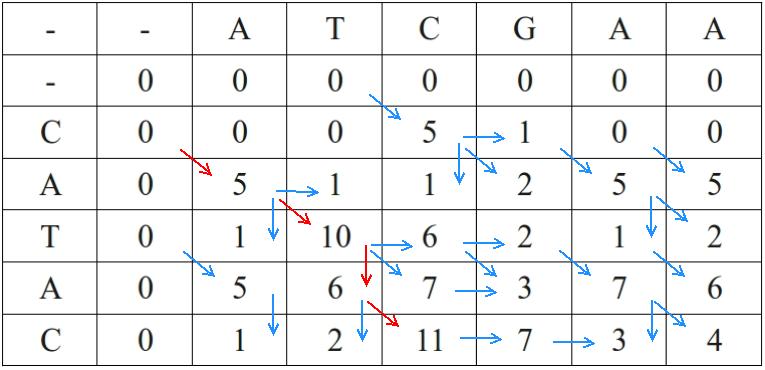
Smith–Waterman algorithm
Algorithm performs local sequence alignment
The Smith–Waterman algorithm performs local sequence alignment; that is, for determining similar regions between two strings of nucleic acid sequences or protein sequences. Instead of looking at the entire sequence, the Smith–Waterman algorithm compares segments of all possible lengths and optimizes the similarity measure.
Nº Q1683352 ★
Common · History
Smith–Waterman algorithm
Algorithm performs local sequence alignment
The Smith–Waterman algorithm performs local sequence alignment; that is, for determining similar regions between two strings of nucleic acid sequences or protein sequences. Instead of looking at the entire sequence, the Smith–Waterman algorithm compares segments of all possible lengths and optimizes the similarity measure.
From Wikipedia
The Smith–Waterman algorithm performs local sequence alignment; that is, for determining similar regions between two strings of nucleic acid sequences or protein sequences. Instead of looking at the entire sequence, the Smith–Waterman algorithm compares segments of all possible lengths and optimizes the similarity measure. The algorithm was first proposed by Temple F. Smith and Michael S. Waterman in 1981. Like the Needleman–Wunsch algorithm, of which it is a variation, Smith–Waterman is a dynamic programming algorithm. As such, it has the desirable property that it is guaranteed to find the optimal local alignment with respect to the scoring system being used (which includes the substitution matrix and the gap-scoring scheme). The main difference to the Needleman–Wunsch algorithm is that negative scoring matrix cells are set to zero. Traceback procedure starts at the highest scoring matrix cell and proceeds until a cell with score zero is encountered, yielding the highest scoring local alignment. Because of its quadratic time complexity, it often cannot be practically applied to large-scale problems and is replaced in favor of computationally more efficient alternatives such as (Gotoh, 1982), (Altschul and Erickson, 1986), and (Myers and Miller, 1988).
Text: Wikipédia, CC BY-SA 4.0. · Image: Wikipedista JockBanan (CC0) ·
Related cards
-

Needleman–Wunsch algorithm
Algorithm
Nº Q583546 ★
Not listed
-
S
Schreier–Sims algorithm
Polynomial algorithm for order of permutation group computation
Nº Q7432874 ★
Not listed
-
B
Brent's method
Root-finding algorithm
Nº Q905988 ★
Not listed
-
T
Thompson's construction
Algorithm relating regular expressions to NFAs
Nº Q7795667 ★
Not listed
-
H
Held–Karp algorithm
Solution of the traveling salesman problem
Nº Q20203442 ★
Not listed
-

Gram–Schmidt process
Method for orthonormalising a set of vectors
Nº Q475239 ★★★
Not listed