

Speedcoding
Programming language
Speedcoding, Speedcode or SpeedCo was the first high-level programming language created for an IBM computer. The language was developed by John W. Backus in 1953 for the IBM 701 to support computation with floating point numbers.
Nº Q7475416 ★
Common · Knowledge
Speedcoding
Programming language
Speedcoding, Speedcode or SpeedCo was the first high-level programming language created for an IBM computer. The language was developed by John W. Backus in 1953 for the IBM 701 to support computation with floating point numbers.
From Wikipedia
Speedcoding, Speedcode or SpeedCo was the first high-level programming language created for an IBM computer. The language was developed by John W. Backus in 1953 for the IBM 701 to support computation with floating point numbers. The idea arose from the difficulty of programming the IBM SSEC machine when Backus was hired to calculate astronomical positions in early 1950. The speedcoding system was an interpreter and focused on ease of use at the expense of system resources. It provided pseudo-instructions for common mathematical functions: logarithms, exponentiation, and trigonometric operations. The resident software analyzed pseudo-instructions one by one and called the appropriate subroutine. Speedcoding was also the first implementation of decimal input/output operations. Although it substantially reduced the effort of writing many jobs, the running time of a program that was written with the help of Speedcoding was usually ten to twenty times that of machine code. The interpreter took 310 memory words, about 30% of the memory available on a 701.
Text: Wikipédia, CC BY-SA 4.0. ·
Related cards
-
L
LevelDB
Open-source key-value store system written by Google
Nº Q630473 ★
Not listed
-

History of software
Description of the evolution and development of software throughout history
Nº Q17155144 ★
Not listed
-
J
John Cocke (computer scientist)
American computer scientist (1925-2002)
Nº Q92632 ★★
Not listed
-
E
ECMAScript
General-purpose programming language on which JavaScript and other languages are based
Nº Q259138 ★★
Not listed
-

GPSS
General-purpose programming language
Nº Q1486554 ★
Not listed
-

Code-2
Type of processors
Nº Q5776017 ★
Not listed
-
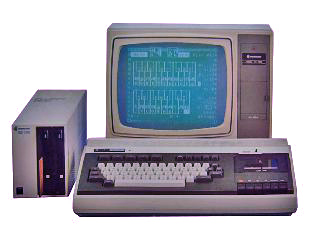
SPC-1000
Personal computer produced by Samsung
Nº Q12600265 ★★
Not listed
-

Frances Allen
American computer scientist (1932–2020)
Nº Q9602 ★
Not listed
-
V
Verilog
Hardware description language
Nº Q827773 ★★
Not listed
-

PETSCII
Character encoding on Commodore computers
Nº Q1022979 ★
Not listed
-

VHDL
Hardware Description Language
Nº Q209455 ★★
Not listed
-

74181
7400 Series TTL Arithmetic Logic Unit IC
Nº Q4643313 ★
Not listed
-

X87
Part of x86 instruction set architecture for floating-point arithmetic
Nº Q291904 ★★
Not listed
-

Nimrod (computer)
Special purpose computer that played the game of Nim
Nº Q1974600 ★
Not listed
-

Jean Ichbiah
French computer scientist (1940-2007)
Nº Q92853 ★★
Not listed
-
B
Blitz BASIC
Programming language family
Nº Q143419 ★★
Not listed
-
C
Create, read, update and delete
Four basic functions of persistent storage in computer programming
Nº Q60500 ★★★
Not listed
-

Range coding
Entropy coding method defined by G. Nigel N. Martin in a 1979 paper, which effectively rediscovered the FIFO arithmetic code first introduced by Richard Clark Pasco in 1976
Nº Q818947 ★
Not listed