

Three-two pull down
Term used in filmmaking and television production for the post-production process of transferring film to video
Three-two pull down (3:2 pull down) is a term used in filmmaking and television production for the post-production process of transferring film to video. It converts 24 frames per second into 29.97 interlaced frames per second, converting approximately every four frames into five frames plus a slight slow down in speed.
Nº Q7797292 ★
Common · History
Three-two pull down
Term used in filmmaking and television production for the post-production process of transferring film to video
Three-two pull down (3:2 pull down) is a term used in filmmaking and television production for the post-production process of transferring film to video. It converts 24 frames per second into 29.97 interlaced frames per second, converting approximately every four frames into five frames plus a slight slow down in speed.
From Wikipedia
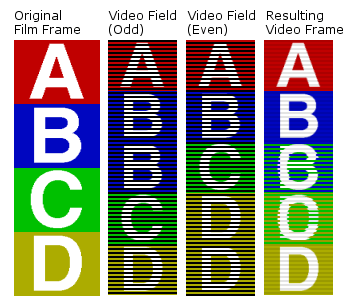
Three-two pull down (3:2 pull down) is a term used in filmmaking and television production for the post-production process of transferring film to video. It converts 24 frames per second into 29.97 interlaced frames per second, converting approximately every four frames into five frames plus a slight slow down in speed. It can also refer to converting 24 frames per second into 59.94 frames per second on modern 60 Hz progressive displays. Film runs at a standard rate of 24 frames per second, whereas NTSC video has a signal frame rate of 29.97 frames per second. Every interlaced video frame has two fields for each frame. The three-two pull down is where the telecine adds a third video field (a half frame) to every second video frame, but the untrained eye cannot see the addition of this extra video field. In the figure, the film frames A–D are the true or original images since they have been photographed as a complete frame. The A, B, and D frames on the right in the NTSC footage are original frames. The third and fourth frames have been created by blending fields from different frames.
Text: Wikipédia, CC BY-SA 4.0. · Image: en:User:Brion VIBBER, en:User:Nate Silva (CC BY-SA 3.0) ·
Related cards
-

High frame rate
Frame rate technology with a higher frame rate than the former conventional frame rates
Nº Q64809 ★
Not listed
-
2
24p
Video format that operates at 24 frames per second frame rate with progressive scanning
Nº Q217323 ★
Not listed
-
D
Deinterlacing
Process of converting interlaced video
Nº Q1183336 ★
Not listed
-
I
Interpolation (computer graphics)
Computer graphics method
Nº Q11713455 ★★
Not listed
-

Three-CCD camera
Camera whose imaging system uses three separate charge-coupled devices
Nº Q313592 ★
Not listed
-

Quad data rate
Communication signaling technique
Nº Q1408949 ★
Not listed