

Common · Knowledge
Vertex-transitive graph
Graph whose automorphism group acts transitively upon its vertices
In the mathematical field of graph theory, an automorphism is a permutation of the vertices such that edges are mapped to edges and non-edges are mapped to non-edges. A graph is a vertex-transitive graph if, given any two vertices v1 and v2 of G, there is an automorphism f such that f ( v 1 ) = v 2 . {\displaystyle f(v_{1})=v_{2}.\ } In other words, a graph is vertex-transitive if its automorphism group acts transitively on its vertices.
From Wikipedia
In the mathematical field of graph theory, an automorphism is a permutation of the vertices such that edges are mapped to edges and non-edges are mapped to non-edges. A graph is a vertex-transitive graph if, given any two vertices v1 and v2 of G, there is an automorphism f such that f ( v 1 ) = v 2 . {\displaystyle f(v_{1})=v_{2}.\ } In other words, a graph is vertex-transitive if its automorphism group acts transitively on its vertices. A graph is vertex-transitive if and only if its graph complement is, since the group actions are identical. Every symmetric graph without isolated vertices is vertex-transitive, and every vertex-transitive graph is regular. However, not all vertex-transitive graphs are symmetric (for example, the edges of the truncated tetrahedron), and not all regular graphs are vertex-transitive (for example, the Frucht graph and Tietze's graph).
Text: Wikipédia, CC BY-SA 4.0. · Image: Tomruen (CC BY-SA 4.0) ·
Related cards
-
 ★
★
Dual graph
Graph representing faces of another graph
-
 ★★
★★
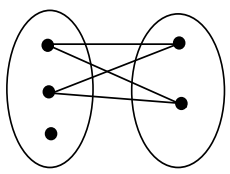
Bipartite graph
Graph whose vertices can be divided into two disjoint and independent sets
-
 ★★
★★
Degree (graph theory)
Number of edges incident to a given vertex in a node-link graph
-
 ★
★
Disjoint union of graphs
Combining the vertex and edge sets of two graphs
-
 ★★
★★
Symmetric group
Group of bijective automorphisms of a set, also called bijective group: the group of bijections on a set (the group of all its permutations), whose group operation is function composition
-
 ★★★
★★★
Tree (graph theory)
Undirected, connected and acyclic graph