Uncommon · Knowledge
YIQ
Color space
YIQ is the color space used by the analog NTSC color TV system. I stands for in-phase, while Q stands for quadrature, referring to the components used in quadrature amplitude modulation. Other TV systems used different color spaces, such as YUV for PAL or YDbDr for SECAM.
From Wikipedia
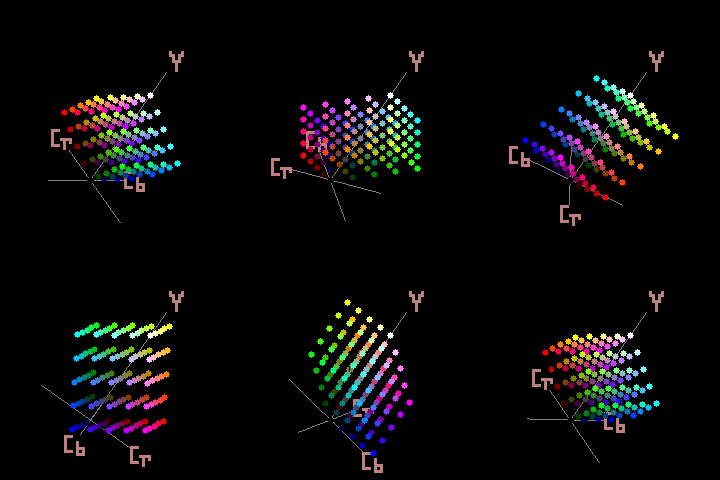
YIQ is the color space used by the analog NTSC color TV system. I stands for in-phase, while Q stands for quadrature, referring to the components used in quadrature amplitude modulation. Other TV systems used different color spaces, such as YUV for PAL or YDbDr for SECAM. Later digital standards use the YCbCr color space. These color spaces are all broadly related, and work based on the principle of adding a color component named chrominance, to a black and white image named luma. In YIQ the Y component represents the luma information, and is the only component used by black-and-white television receivers. I and Q represent the chrominance information, with I indicating (roughly) orange-blue contrast, and Q indicating purple-green contrast. I and Q can be thought of as a second pair of axes on the same graph as the YUV color space, rotated 33°; therefore IQ and UV represent different coordinate systems on the same plane. The YIQ system is intended to take advantage of human color-response characteristics. The eye is more sensitive to changes in the orange-blue (I) range than in the purple-green range (Q)—therefore less bandwidth is required for Q than for I. Broadcast NTSC limits I to 1.3 MHz and Q to 0.4 MHz. I and Q are frequency interleaved into the 4 MHz Y signal, which keeps the bandwidth of the overall signal down to 4.2 MHz. In YUV systems, since U and V both contain information in the orange-blue range, both components must be given the same amount of bandwidth as I to achieve similar color fidelity. Very few television sets perform true I and Q decoding, due to the high costs of such an implementation. Compared to the cheaper R-Y and B-Y decoding which requires only one filter, I and Q each requires a...
Text: Wikipédia, CC BY-SA 4.0. · Image: Tonyle (CC BY-SA 3.0) ·