


FOSB
Gen de la especie Homo sapiens
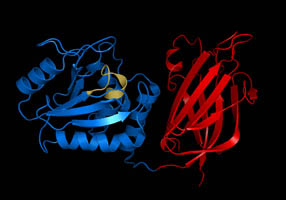
Protein fosB, also known as FosB and G0/G1 switch regulatory protein 3 (G0S3), is a protein that in humans is encoded by the FBJ murine osteosarcoma viral oncogene homolog B (FOSB) gene. The FOS gene family consists of four members: FOS, FOSB, FOSL1, and FOSL2.
Nº Q17929096 ★
Común · Saberes
FOSB
Gen de la especie Homo sapiens
Protein fosB, also known as FosB and G0/G1 switch regulatory protein 3 (G0S3), is a protein that in humans is encoded by the FBJ murine osteosarcoma viral oncogene homolog B (FOSB) gene. The FOS gene family consists of four members: FOS, FOSB, FOSL1, and FOSL2.
En Wikipedia
Texto en inglés Aún no hay artículo en tu idioma: extracto en inglés.
Protein fosB, also known as FosB and G0/G1 switch regulatory protein 3 (G0S3), is a protein that in humans is encoded by the FBJ murine osteosarcoma viral oncogene homolog B (FOSB) gene. The FOS gene family consists of four members: FOS, FOSB, FOSL1, and FOSL2. These genes encode leucine zipper proteins that can dimerize with proteins of the JUN family (e.g., c-Jun, JunD), thereby forming the transcription factor complex AP-1. As such, the FOS proteins have been implicated as regulators of cell proliferation, differentiation, and transformation. FosB and its truncated splice variants, ΔFosB and further truncated Δ2ΔFosB, are all involved in osteosclerosis, although Δ2ΔFosB lacks a known transactivation domain, in turn preventing it from affecting transcription through the AP-1 complex. The ΔFosB splice variant has been identified as playing a central, crucial role in the development and maintenance of addiction. ΔFosB overexpression (i.e., an abnormally and excessively high level of ΔFosB expression which produces a pronounced gene-related phenotype) triggers the development of addiction-related neuroplasticity throughout the reward system and produces a behavioral phenotype that is characteristic of an addiction. ΔFosB differs from the full length FosB and further truncated Δ2ΔFosB in its capacity to produce these effects, as only accumbal ΔFosB overexpression is associated with pathological responses to drugs.
Texto: Wikipedia en inglés, CC BY-SA 4.0. · Imagen: National Center for Biotechnology Information, U.S. National... (Public domain) ·
Cartas cercanas
-

HOXD13
Gen de la especie Homo sapiens
Nº Q18027230 ★
Sin ofertas
-

Myc
Nº Q420267 ★
Sin ofertas
-

ZZZ3
Gen de la especie Homo sapiens
Nº Q18037868 ★★★
Sin ofertas
-
PTEN
Nº Q416356 ★
Sin ofertas
-

PPP1R1B
Gen de la especie Homo sapiens
Nº Q18047432 ★
Sin ofertas
-

LRP5
Gen de la especie Homo sapiens.
Nº Q18028670 ★
Sin ofertas