

Poco común · Lugares
Mount Baoding Buddhist Sculptures
Part of the Classical Gardens of Chongqing, China
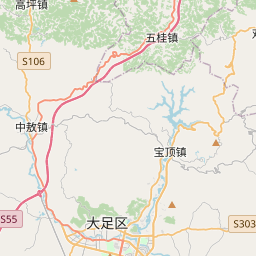
Baodingshan (simplified Chinese: 宝顶山; traditional Chinese: 寶頂山; also known as Mount Baoding, Precious Summit Mountain, and Summit of Treasures) is a Buddhist site in Chongqing. The site is located on a limestone outcropping at an elevation of 500 meters, fifteen kilometers north of the center of Dazu District, a market town that dates to 758 CE and the city is ringed by religious sites dating from 892 to 1249 CE.
En el mapa
En Wikipedia
Texto en inglés Aún no hay artículo en tu idioma: extracto en inglés.
Baodingshan (simplified Chinese: 宝顶山; traditional Chinese: 寶頂山; also known as Mount Baoding, Precious Summit Mountain, and Summit of Treasures) is a Buddhist site in Chongqing. The site is located on a limestone outcropping at an elevation of 500 meters, fifteen kilometers north of the center of Dazu District, a market town that dates to 758 CE and the city is ringed by religious sites dating from 892 to 1249 CE. Primary construction at Baodingshan took place during the Southern Song dynasty (1127–1279 CE) but it remained largely unknown to the outside world until its reopening to the public in the 1980s, the earliest documented research on the site dating to 1944. The site has since been designated a World Heritage Site since 1999, falling within the collective grouping of Dazu Rock Carvings, a reference to the district in which Baodingshan is located. Dazu County covers 1400 square kilometers northwest of Chongqing on the road to Chengdu. During the Song dynasty (960–1279 CE), this area of the Chengdu plain was considered one of the wealthiest regions in China. Consisting of a mile and a half of carvings, numbering over 6000 total, Baodingshan is an atypical Chinese Buddhist site for a variety of reasons: it includes both large scale iconic works as well as intricate narrative tableaux; it represents a variety of Buddhist schools of thought – Huayan, Chan, Pure Land, and Esoteric; it has copious amounts of Buddhist texts carved in conjunction with imagery; and it was constructed within 70 years under the supervision of one man, Zhao Zhifeng. Baodingshan consists of two main parts joined by a temple, Shengshousi [Sagacious Longevity Temple 圣寿寺 / 聖壽寺]. Best known to the outside world is Great Buddha Bend [Dafowan 大佛弯 / 大佛彎] due to its impressive collection of 31 tableaux featuring imagery such as the parinirvana of the historical Buddha, the hells scenes, the Peacock Queen and numerous other narrative tableaux, the most widely reproduced being the Taming the Wild Ox. Great Buddha Bend also claims some of the biggest Chinese versions of certain Buddhist works – in particular the Hell tableau and the 1000-Armed 1000-Eyed Avalokitesvara or Guanyin figure.
Texto: Wikipedia en inglés, CC BY-SA 4.0. · Imagen: G41rn8 (CC BY-SA 4.0) ·