

Común · Saberes
Rayleigh–Ritz method
Method for approximating eigenvalues
The Rayleigh–Ritz method is a direct numerical method of approximating eigenvalues, which originated in the context of solving physical boundary-value problems. It is named after Lord Rayleigh and Walther Ritz.
En Wikipedia
Texto en inglés Aún no hay artículo en tu idioma: extracto en inglés.
The Rayleigh–Ritz method is a direct numerical method of approximating eigenvalues, which originated in the context of solving physical boundary-value problems. It is named after Lord Rayleigh and Walther Ritz. In this method, an infinite-dimensional linear operator is approximated by a finite-dimensional compression, enabling the use of a numerical eigenvalue algorithm. It is used in all applications that involve approximating eigenvalues and eigenvectors, often under different names. In quantum mechanics, where a system of particles is described using a Hamiltonian, it uses trial wave functions to approximate the ground-state eigenfunction. In the context of the finite-element method, it is mathematically the same as the Ritz-Galerkin method. In mechanical and structural engineering, it is used to approximate the eigenmodes and resonant frequencies of a structure. A related adaption of Rayleigh-Ritz known as Hamiltonian truncation can be used in quantum field theory.
Texto: Wikipedia en inglés, CC BY-SA 4.0. ·
Cartas cercanas
-
H★
Heun's method
The numerical procedure for solving ordinary differential equations with a given initial value created by Karl Heun.
-
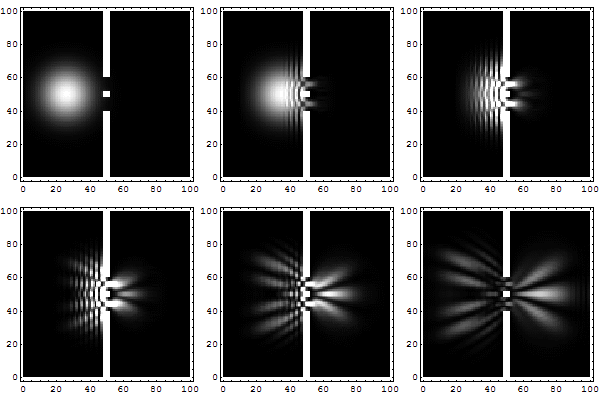 ★
★
Método de Crank-Nicolson
-
M★★
Método de Hartree-Fock
Método de aproximación para la determinación de la función de onda y la energía de un sistema cuántico de muchos cuerpos en un estado estacionario
-
 ★
★
Extrapolación de Richardson
-
 ★★★
★★★
Algoritmo símplex
Método Simplex
-
 ★★
★★
Método de Frobenius