

Space-Based Infrared System
American early warning system
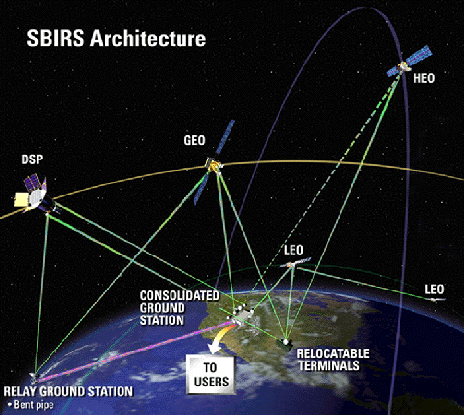
The Space-Based Infrared System (SBIRS) is a United States Space Force system intended to meet the United States' Department of Defense infrared space surveillance needs through the first two to three decades of the 21st century. The SBIRS program is designed to provide key capabilities in the areas of missile warning, missile defense, battlespace characterization and technical intelligence via satellites in geosynchronous Earth orbit (GEO), sensors hosted on satellites in highly elliptical orbit (HEO), and ground-based data processing and cont...
Nº Q905215 ★
Común · Saberes
Space-Based Infrared System
American early warning system
The Space-Based Infrared System (SBIRS) is a United States Space Force system intended to meet the United States' Department of Defense infrared space surveillance needs through the first two to three decades of the 21st century. The SBIRS program is designed to provide key capabilities in the areas of missile warning, missile defense, battlespace characterization and technical intelligence via satellites in geosynchronous Earth orbit (GEO), sensors hosted on satellites in highly elliptical orbit (HEO), and ground-based data processing and cont...
En Wikipedia
Texto en inglés Aún no hay artículo en tu idioma: extracto en inglés.
The Space-Based Infrared System (SBIRS) is a United States Space Force system intended to meet the United States' Department of Defense infrared space surveillance needs through the first two to three decades of the 21st century. The SBIRS program is designed to provide key capabilities in the areas of missile warning, missile defense, battlespace characterization and technical intelligence via satellites in geosynchronous Earth orbit (GEO), sensors hosted on satellites in highly elliptical orbit (HEO), and ground-based data processing and control. A total of twelve satellites carrying SBIRS or STSS payloads had been launched: SBIRS GEO-1 (USA-230, 2011), SBIRS GEO-2 (USA-241, 2013), SBIRS GEO-3 (USA-273, 2017), SBIRS GEO-4 (USA-282, 2018), SBIRS GEO-5 (USA-315, 2021), SBIRS GEO-6 (USA-336, 2022), SBIRS HEO-1 (USA-184, 2006), SBIRS HEO-2 (USA-200, 2008), SBIRS HEO-3 (USA-259, 2014), STSS-ATRR (USA-205, 2009), STSS Demo 1 (USA-208, 2009) and STSS Demo 2 (USA-209, 2009). The manufacturing contract for SBIRS GEO-5 and SBIRS GEO-6 was awarded in 2014. Funding for SBIRS GEO-7 and SBIRS GEO-8 was canceled in 2019.
Texto: Wikipedia en inglés, CC BY-SA 4.0. · Imagen: US Air Force (Public domain) ·
Cartas cercanas
-
N
Next-Generation Overhead Persistent Infrared
American space program for detecting the launch of intercontinental ballistic missiles
Nº Q109039961 ★
Sin ofertas
-

Telescopio espacial Spitzer
Observatorio espacial infrarrojo
Nº Q201953 ★★★
Sin ofertas
-

Wide-field Infrared Survey Explorer
Nº Q693552 ★
Sin ofertas
-

Ibuki (satélite)
Satélite de observación terrestre
Nº Q925312 ★
Sin ofertas
-

Imagen satelital
Fotografía tomada desde un satélite artificial
Nº Q725252 ★★★
Sin ofertas
-

GRAVES (system)
French radar-based space surveillance system
Nº Q3416355 ★★
Sin ofertas