

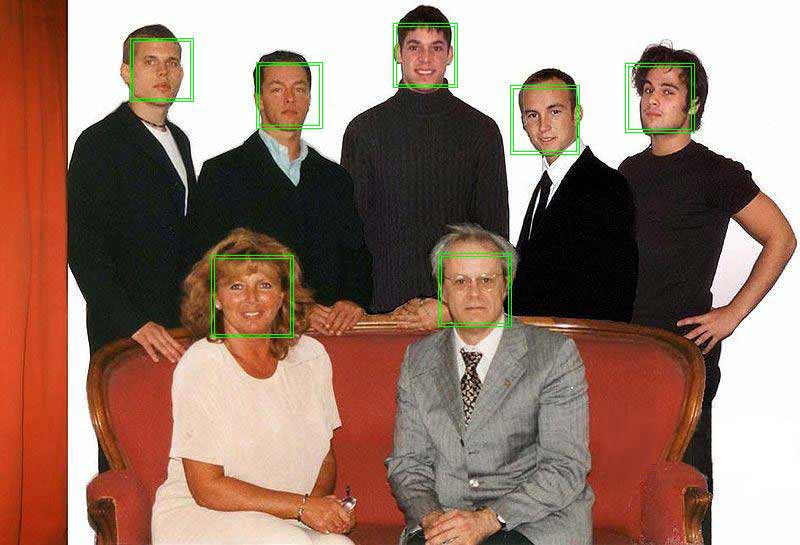
Viola–Jones object detection framework
Machine learning algorithm
The Viola–Jones object detection framework is a machine learning object detection framework proposed in 2001 by Paul Viola and Michael Jones. It was motivated primarily by the problem of face detection, although it can be adapted to the detection of other object classes.
Nº Q2493877 ★
Común · Literatura
Viola–Jones object detection framework
Machine learning algorithm
The Viola–Jones object detection framework is a machine learning object detection framework proposed in 2001 by Paul Viola and Michael Jones. It was motivated primarily by the problem of face detection, although it can be adapted to the detection of other object classes.
En Wikipedia
Texto en inglés Aún no hay artículo en tu idioma: extracto en inglés.
The Viola–Jones object detection framework is a machine learning object detection framework proposed in 2001 by Paul Viola and Michael Jones. It was motivated primarily by the problem of face detection, although it can be adapted to the detection of other object classes. In short, it consists of a sequence of classifiers. Each classifier is a single perceptron with several binary masks (Haar features). To detect faces in an image, a sliding window is computed over the image. For each image, the classifiers are applied. If at any point, a classifier outputs "no face detected", then the window is considered to contain no face. Otherwise, if all classifiers output "face detected", then the window is considered to contain a face. The algorithm is efficient for its time, able to detect faces in 384 by 288 pixel images at 15 frames per second on a conventional 700 MHz Intel Pentium III. It is also robust, achieving high precision and recall. While it has lower accuracy than more modern methods such as convolutional neural network, its efficiency and compact size (only around 50k parameters, compared to millions of parameters for typical CNN like DeepFace) means it is still used in cases with limited computational power. For example, in the original paper, they reported that this face detector could run on the Compaq iPAQ at 2 fps (this device has a low power StrongARM without floating point hardware).
Texto: Wikipedia en inglés, CC BY-SA 4.0. · Imagen: FUSIA_Board_1998_L.jpg: F.U.S.I.A. assistant derivative work... (Public domain) ·
Cartas cercanas
-

Scale-invariant feature transform
Nº Q767770 ★
Sin ofertas
-

Consulta de imágenes mediante ejemplo
Método de recuperación de imágenes
Nº Q1128648 ★
Sin ofertas
-
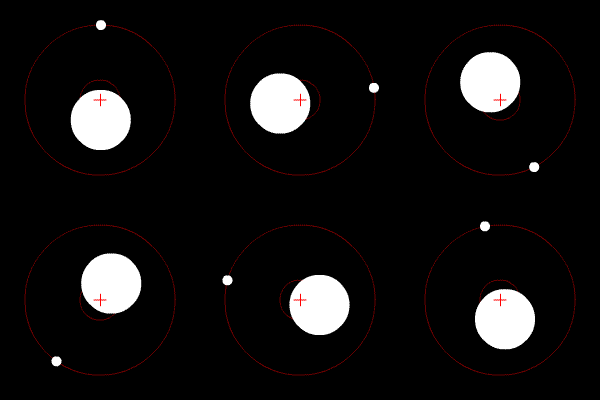
Espectroscopia Doppler
Método para encontrar planetas extrasolares
Nº Q2273386 ★
Sin ofertas
-
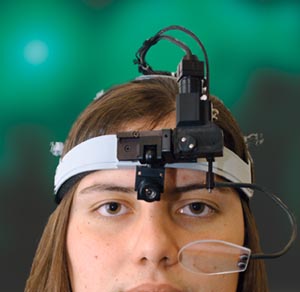
Seguimiento de ojos
Medir el punto de la mirada o el movimiento de un ojo en relación con la cabeza
Nº Q970687 ★★
Sin ofertas
-
C
CIFAR-10
Image dataset
Nº Q45037095 ★
Sin ofertas
-

Teledetección
Adquisición de información sobre un objeto o fenómeno sin contacto directo con el mismo, habitualmente, la Tierra
Nº Q199687 ★★★
Sin ofertas