

Commune · Savoirs
dynamique du solide
Mécanique appliquée à des solides rigides dotés d'une inertie massique
In classical mechanics, rigid body dynamics studies the movement of systems of interconnected bodies under the action of external forces. Along with statics, it forms the field of rigid body mechanics.
Sur Wikipédia
Texte en anglais Pas encore d'article dans ta langue : extrait en anglais.
In classical mechanics, rigid body dynamics studies the movement of systems of interconnected bodies under the action of external forces. Along with statics, it forms the field of rigid body mechanics. The assumption that the bodies are rigid (i.e. they do not deform under the action of applied forces) simplifies analysis, by reducing the parameters that describe the configuration of the system to the translation and rotation of body-fixed frames. This excludes bodies that display fluid, highly elastic, and plastic behavior. The dynamics of a rigid body system is described by the laws of kinematics and by the application of Newton's second law (kinetics) or their derivative form, Lagrangian mechanics. The solution of these equations of motion provides a description of the position, the motion and the acceleration of the individual components of the system, and overall the system itself, as a function of time. The formulation and solution of rigid body dynamics is an important tool in the computer simulation of mechanical systems.
Texte : Wikipédia en anglais, CC BY-SA 4.0. · Image : Robert Henry Thurston (1839–1903) (Public domain) ·
Cartes voisines
-
S★
Structural dynamics
Behavior of a structure subjected to dynamic (actions having high acceleration) loading
-
 ★★★
★★★
Dynamique (mécanique)
Branche de la mécanique qui étudie les mouvements des corps sous l'action de forces et de moments en ses points
-
 ★★
★★
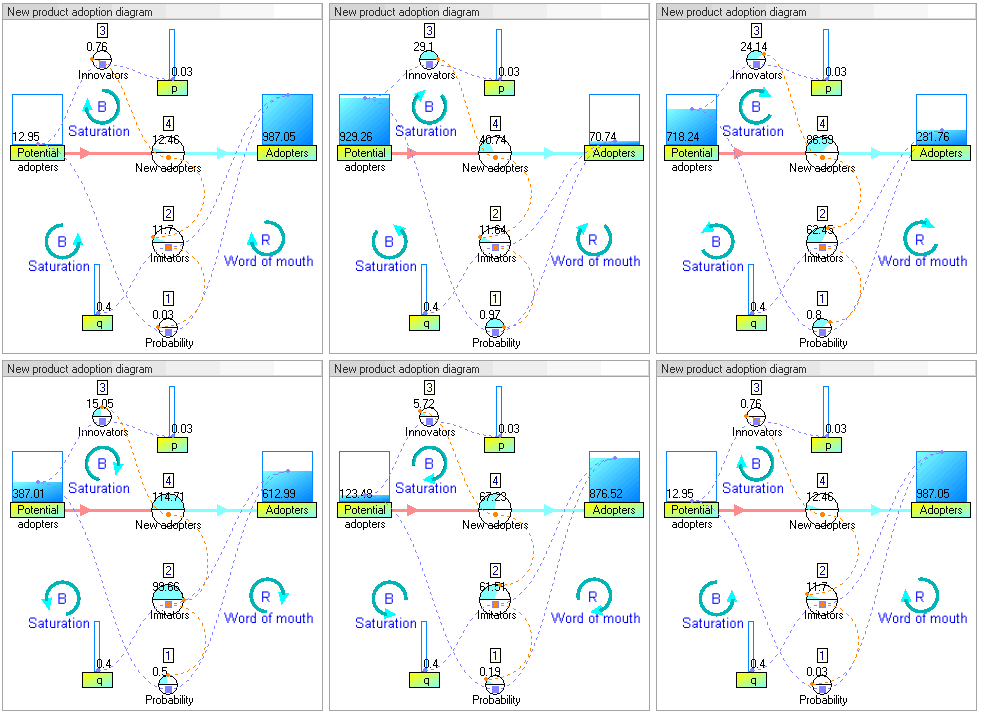
Dynamique des systèmes
Modélisation de systèmes complexes par des stocks, des flux et des boucles de rétroaction
-
 ★★
★★
hydrodynamique
Study of fluids in motion
-
Q★★
Quantum dynamics
Study of quantum systems changing with time
-
 ★★
★★
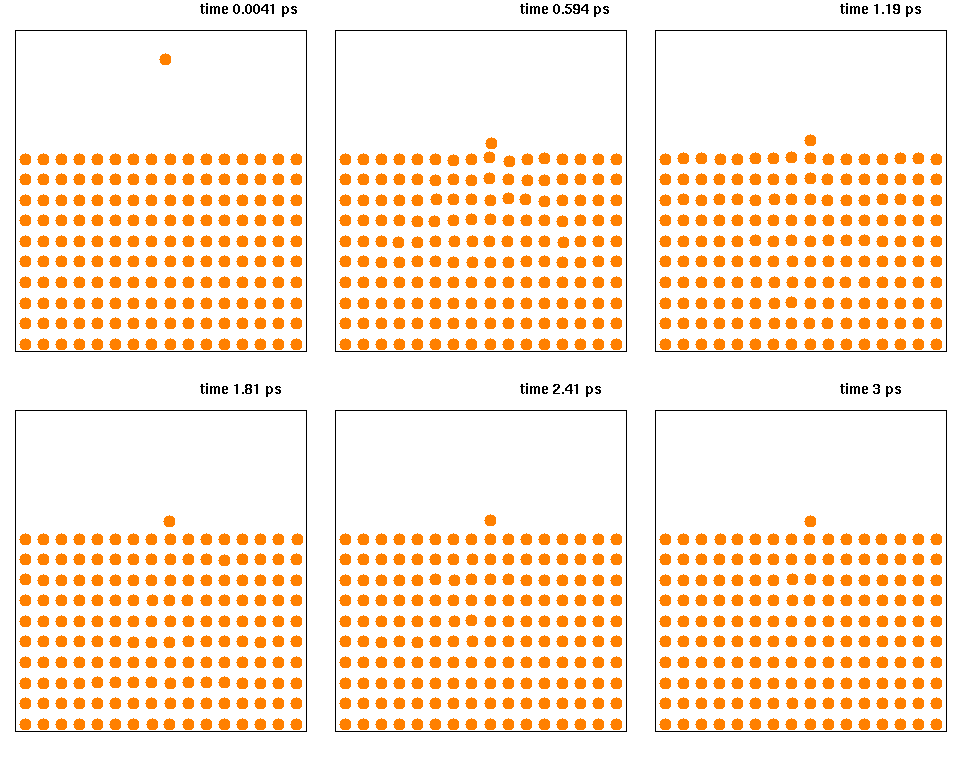
Dynamique moléculaire