

Commune · Savoirs
Oceanic zone
Part of the ocean beyond the continental shelf
The oceanic zone is typically defined as the area of the ocean lying beyond the continental shelf (e.g. the neritic zone), but operationally is often referred to as beginning where the water depths drop to below 200 metres (660 ft), seaward from the coast into the open ocean with its pelagic zone. It is the region of open sea beyond the edge of the continental shelf and includes 65% of the ocean's completely open water.
Sur Wikipédia
Texte en anglais Pas encore d'article dans ta langue : extrait en anglais.
The oceanic zone is typically defined as the area of the ocean lying beyond the continental shelf (e.g. the neritic zone), but operationally is often referred to as beginning where the water depths drop to below 200 metres (660 ft), seaward from the coast into the open ocean with its pelagic zone. It is the region of open sea beyond the edge of the continental shelf and includes 65% of the ocean's completely open water. The oceanic zone has a wide array of undersea terrain, including trenches that are often deeper than Mount Everest is tall, as well as deep-sea volcanoes and basins. While it is often difficult for life to sustain itself in this type of environment, many species have adapted and do thrive in the oceanic zone. The open ocean is vertically divided into five zones: the epipelagic zone, mesopelagic zone, bathypelagic zone, abyssopelagic zone, and hadalpelagic zone.
Texte : Wikipédia en anglais, CC BY-SA 4.0. · Image : Chris huh (Original text : K. Aainsqatsi) / K. Aainsqatsi (Public domain) ·
Cartes voisines
-
 ★★★★★
★★★★★
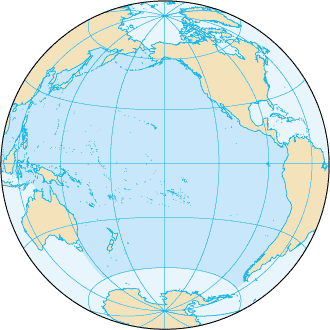
Océan Pacifique
Océan le plus vaste du globe terrestre
-
 ★
★
plateau continental extérieur
Type de zone maritime américaine
-
 ★★★★
★★★★
Océan Austral
Étendue d'eau entourant l’Antarctique
-
F★★★
Fosse du Pérou-Chili
-
 ★★★
★★★
bassin de la mer Adriatique
Oceanic basin under the Adriatic Sea
-
 ★★
★★
Ocean deoxygenation
Expansion of oxygen minimum zones in oceans