

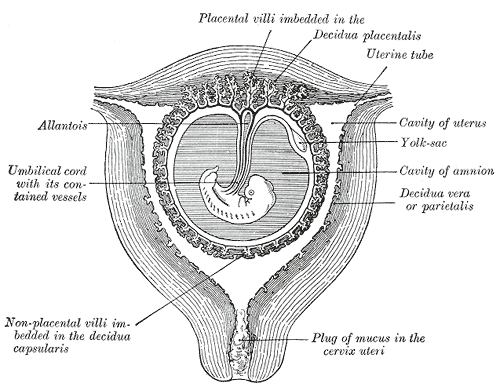
Decidualization
The cellular and vascular changes occurring in the endometrium of the pregnant uterus just after the onset of blastocyst implantation. This process involves the proliferation and differentiation of the fibroblast-like endometrial stromal cells into l
Decidualization is a process that results in significant changes to cells of the endometrium in preparation for, and during, pregnancy. This includes morphological and functional changes (the decidual reaction) to endometrial stromal cells (ESCs), the presence of decidual white blood cells (leukocytes), and vascular changes to maternal arteries.
Nº Q1207365 ★
Comum · História
Decidualization
The cellular and vascular changes occurring in the endometrium of the pregnant uterus just after the onset of blastocyst implantation. This process involves the proliferation and differentiation of the fibroblast-like endometrial stromal cells into l
Decidualization is a process that results in significant changes to cells of the endometrium in preparation for, and during, pregnancy. This includes morphological and functional changes (the decidual reaction) to endometrial stromal cells (ESCs), the presence of decidual white blood cells (leukocytes), and vascular changes to maternal arteries.
Na Wikipédia
Texto em inglês Ainda não há artigo no seu idioma: trecho em inglês.
Decidualization is a process that results in significant changes to cells of the endometrium in preparation for, and during, pregnancy. This includes morphological and functional changes (the decidual reaction) to endometrial stromal cells (ESCs), the presence of decidual white blood cells (leukocytes), and vascular changes to maternal arteries. The sum of these changes results in the endometrium changing into a structure called the decidua. In humans, the decidua is shed during childbirth. Decidualization plays an important role in promoting placenta formation between a mother and her fetus by mediating the invasiveness of trophoblast cells. It also triggers the production of cellular and molecular factors that result in structural changes, or remodeling, of maternal spiral arteries. Decidualization is required in some mammalian species where embryo implantation and trophoblast cell invasion of the endometrium occurs, also known as hemochorial placentation. This allows maternal blood to come into direct contact with the fetal chorion, a membrane between the fetal and maternal tissues, and allows for nutrient and gas exchange. However, decidualization-like reactions have also been observed in some species that don't display hemochorial placentation. In humans, decidualization occurs after ovulation during the menstrual cycle. After implantation of the embryo, the decidua further develops to mediate the process of placentation. In the event no embryo is implanted, the decidualized endometrial lining is shed. In menstruating species, decidualization is spontaneous and occurs as a result of maternal hormones. In non-menstruating species, decidualization is non-spontaneous, meaning it only happens after there are external signals from an implanted embryo.
Texto: Wikipédia em inglês, CC BY-SA 4.0. · Imagem: Henry Vandyke Carter (Public domain) ·
Cartas próximas
-
T
Transdiferenciação
Nº Q2300675 ★
Sem ofertas
-

Ossificação intramembranosa
Nº Q10746904 ★
Sem ofertas
-

Pronúcleo
Nº Q2614103 ★
Sem ofertas
-

Oogênese
Gametogénese feminina
Nº Q507032 ★★
Sem ofertas
-

Fagocitose
Nº Q184726 ★★★
Sem ofertas
-

mtDNA transmission
Mode of inheritance
Nº Q3537727 ★
Sem ofertas