

Comum · História
Ehrenstein illusion
Optical illusion
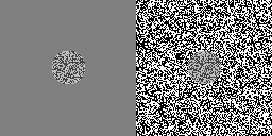
The Ehrenstein illusion is an optical illusion of brightness or color perception. The visual phenomena was studied by the German psychologist Walter H. Ehrenstein (1899–1961) who originally wanted to modify the theory behind the Hermann grid illusion.
Na Wikipédia
Texto em inglês Ainda não há artigo no seu idioma: trecho em inglês.
The Ehrenstein illusion is an optical illusion of brightness or color perception. The visual phenomena was studied by the German psychologist Walter H. Ehrenstein (1899–1961) who originally wanted to modify the theory behind the Hermann grid illusion. In the discovery of the optical illusion, Ehrenstein found that grating patterns of straight lines that stop at a certain point appear to have a brighter centre, compared to the background. Ehrenstein published his book Modifications of the Brightness Phenomenon of L. Hermann to disprove Hermann's theory. He argued that these illusions were not caused by a contrast effect, but rather a brightness effect that needed to be further explored.
Texto: Wikipédia em inglês, CC BY-SA 4.0. · Imagem: Gringer (Public domain) ·
Cartas próximas
-
 ★
★
Illusory contour
Visual illusion that evokes the perception of an edge without a luminance or color change across that edge
-
 ★
★
Irradiation illusion
Type oder illusion
-
 ★
★
Helmholtz–Kohlrausch effect
Perceptual phenomenon
-
 ★
★
Ilusão de Jastrow
-
 ★
★
Fraser spiral illusion
Optical illusion
-
 ★
★
Chubb illusion
Optical illusion