

G-index
Citation metric
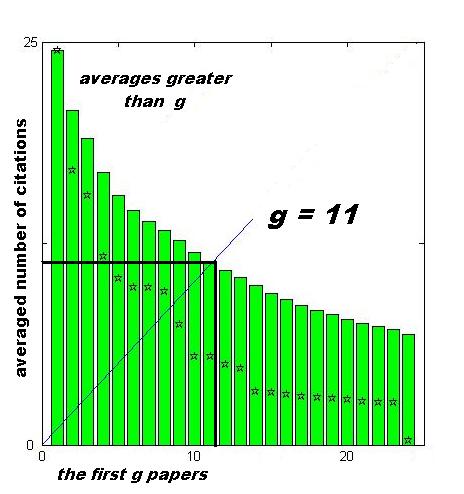
The g-index is an author-level metric suggested in 2006 by Leo Egghe. The index is calculated based on the distribution of citations received by a given researcher's publications, such that given a set of articles ranked in decreasing order of the number of citations that they received, the g-index is the unique largest number such that the top g articles received together at least g2 citations.
Nº Q4472661 ★
Comum · Saberes
G-index
Citation metric
The g-index is an author-level metric suggested in 2006 by Leo Egghe. The index is calculated based on the distribution of citations received by a given researcher's publications, such that given a set of articles ranked in decreasing order of the number of citations that they received, the g-index is the unique largest number such that the top g articles received together at least g2 citations.
Na Wikipédia
Texto em inglês Ainda não há artigo no seu idioma: trecho em inglês.
The g-index is an author-level metric suggested in 2006 by Leo Egghe. The index is calculated based on the distribution of citations received by a given researcher's publications, such that given a set of articles ranked in decreasing order of the number of citations that they received, the g-index is the unique largest number such that the top g articles received together at least g2 citations. Hence, a g-index of 10 indicates that the top 10 publications of an author have been cited at least 100 times (102), a g-index of 20 indicates that the top 20 publications of an author have been cited 400 times (202). It can be equivalently defined as the largest number n of highly cited articles for which the average number of citations is at least n. This is in fact a rewriting of the definition g 2 ≤ ∑ i ≤ g c i {\displaystyle g^{2}\leq \sum _{i\leq g}c_{i}} as g ≤ 1 g ∑ i ≤ g c i . {\displaystyle g\leq {\frac {1}{g}}\sum _{i\leq g}c_{i}.} The g-index is an alternative for the older h-index. The h-index does not average the number of citations. Instead, the h-index only requires a minimum of n citations for the least-cited article in the set and thus ignores the citation count of very highly cited publications. Roughly, the effect is that h is the number of works of a quality threshold that rises as h rises; g allows citations from higher-cited works to be used to bolster lower-cited works in meeting this threshold. In effect, the g-index is the maximum reachable value of the h-index if a fixed number of citations can be distributed freely over a fixed number of publications. Therefore, in all cases g is at least h, and is in most cases higher. The...
Texto: Wikipédia em inglês, CC BY-SA 4.0. · Imagem: Ael 2 (CC BY-SA 3.0) ·
Cartas próximas
-
Í
Índice h
Nº Q310663 ★★★★
Sem ofertas
-

Global Terrorism Index
Report published annually by the Institute for Economics and Peace
Nº Q5570688 ★★
Sem ofertas
-

Index (statistics)
Statistical term; compound measure in statistics
Nº Q18208028 ★
Sem ofertas
-

Science Citation Index
Nº Q104047209 ★
Sem ofertas
-

Diferenças globais entre gêneros
Nº Q892074 ★★
Sem ofertas
-
Í
Índice de um subgrupo
Nº Q1464168 ★
Sem ofertas