

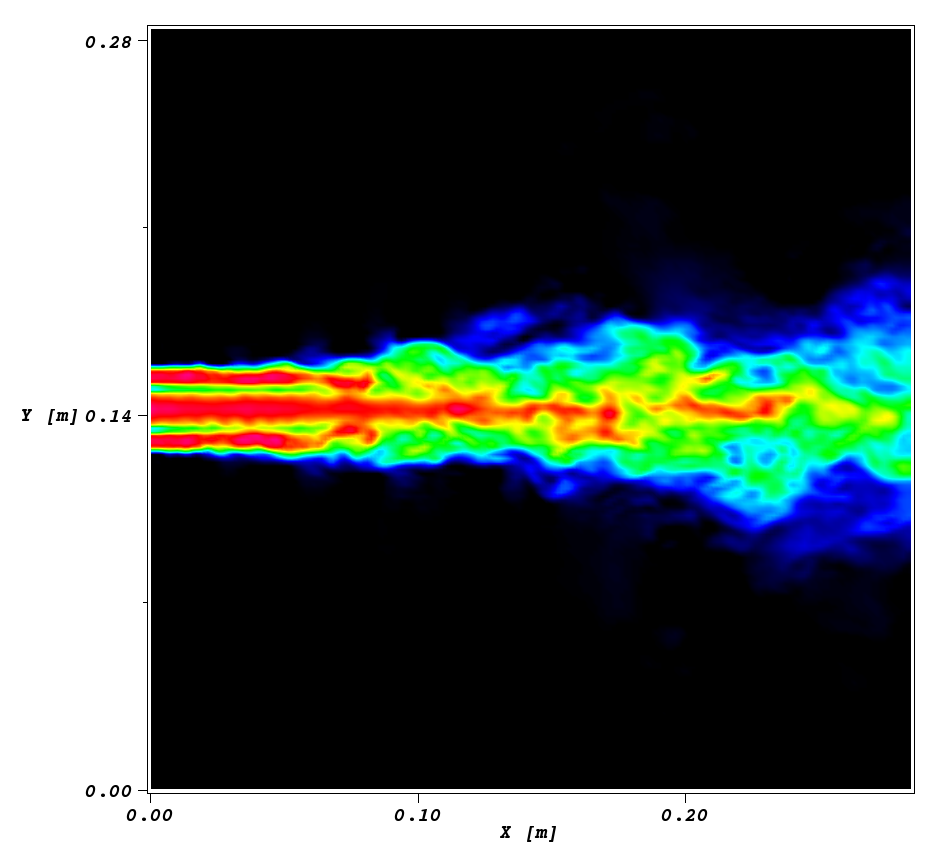
Large eddy simulation
Mathematical model for turbulence
Large eddy simulation (LES) is a mathematical model for turbulence used in computational fluid dynamics. It was initially proposed in 1963 by Joseph Smagorinsky to simulate atmospheric air currents, and first explored by James Deardorff (1970).
Nº Q1755722 ★
Comum · Saberes
Large eddy simulation
Mathematical model for turbulence
Large eddy simulation (LES) is a mathematical model for turbulence used in computational fluid dynamics. It was initially proposed in 1963 by Joseph Smagorinsky to simulate atmospheric air currents, and first explored by James Deardorff (1970).
Na Wikipédia
Texto em inglês Ainda não há artigo no seu idioma: trecho em inglês.
Large eddy simulation (LES) is a mathematical model for turbulence used in computational fluid dynamics. It was initially proposed in 1963 by Joseph Smagorinsky to simulate atmospheric air currents, and first explored by James Deardorff (1970). LES is currently applied in a wide variety of engineering applications, including combustion, acoustics, and simulations of the atmospheric boundary layer. The simulation of turbulent flows by numerically solving the Navier–Stokes equations requires resolving a very wide range of time and length scales, all of which affect the flow field. Such a resolution can be achieved with direct numerical simulation (DNS), but DNS is computationally expensive, and its cost prohibits simulation of practical engineering systems with complex geometry or flow configurations, such as turbulent jets, pumps, vehicles, and landing gear. The principal idea behind LES is to reduce the computational cost by ignoring the smallest length scales, which are the most computationally expensive to resolve, via low-pass filtering of the Navier–Stokes equations. Such a low-pass filtering, which can be viewed as a time- and spatial-averaging, effectively removes small-scale information from the numerical solution. This information is not irrelevant, however, and its effect on the flow field must be modelled, a task which is an active area of research for problems in which small-scales can play an important role, such as near-wall flows, reacting flows, and multiphase flows.
Texto: Wikipédia em inglês, CC BY-SA 4.0. · Imagem: Charlesreid1 (CC BY-SA 3.0) ·
Cartas próximas
-
D
Direct numerical simulation
Simulation in computational fluid dynamics
Nº Q1227572 ★
Sem ofertas
-
L
Lattice Boltzmann methods
Class of computational fluid dynamics methods
Nº Q1807064 ★
Sem ofertas
-

Reynolds equation
Differential equation describing pressure distribution of thin viscous fluids
Nº Q7319639 ★★
Sem ofertas
-
L
LS-DYNA
Nº Q570519 ★
Sem ofertas
-

GPSS
General-purpose programming language
Nº Q1486554 ★
Sem ofertas
-
A
Algoritmo de Levenberg–Marquardt
Nº Q1426494 ★★
Sem ofertas