

Turing's proof
Proof by Alan Turing
Turing's proof is a proof by Alan Turing submitted on 12 November 1936 and first published in 1937 with the title "On Computable Numbers, with an Application to the Entscheidungsproblem". It was the second proof (after Church's theorem) of the negation of Hilbert's Entscheidungsproblem; that is, the conjecture that some purely mathematical yes–no questions can never be answered by computation; more technically, that some decision problems are "undecidable" in the sense that there is no single algorithm that infallibly gives a correct "yes" or "...
Nº Q7854954 ★
Comum · Saberes
Turing's proof
Proof by Alan Turing
Turing's proof is a proof by Alan Turing submitted on 12 November 1936 and first published in 1937 with the title "On Computable Numbers, with an Application to the Entscheidungsproblem". It was the second proof (after Church's theorem) of the negation of Hilbert's Entscheidungsproblem; that is, the conjecture that some purely mathematical yes–no questions can never be answered by computation; more technically, that some decision problems are "undecidable" in the sense that there is no single algorithm that infallibly gives a correct "yes" or "...
Na Wikipédia
Texto em inglês Ainda não há artigo no seu idioma: trecho em inglês.
Turing's proof is a proof by Alan Turing submitted on 12 November 1936 and first published in 1937 with the title "On Computable Numbers, with an Application to the Entscheidungsproblem". It was the second proof (after Church's theorem) of the negation of Hilbert's Entscheidungsproblem; that is, the conjecture that some purely mathematical yes–no questions can never be answered by computation; more technically, that some decision problems are "undecidable" in the sense that there is no single algorithm that infallibly gives a correct "yes" or "no" answer to each instance of the problem. In Turing's own words: "what I shall prove is quite different from the well-known results of Gödel ... I shall now show that there is no general method which tells whether a given formula U is provable in K [Principia Mathematica]". Turing followed this proof with two others. The second and third both rely on the first. All rely on his development of typewriter-like "computing machines" that obey a simple set of rules and his subsequent development of a "universal computing machine".
Texto: Wikipédia em inglês, CC BY-SA 4.0. ·
Cartas próximas
-

Problema da parada
Nº Q622849 ★★★
Sem ofertas
-
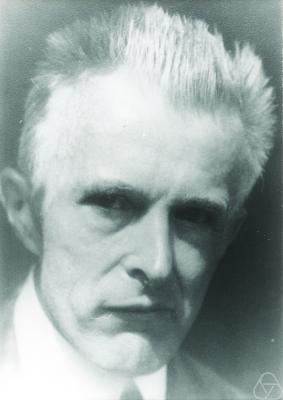
Heinrich Scholz
Professor académico alemão
Nº Q104461 ★
Sem ofertas
-
T
Tese de Church-Turing
Nº Q309157 ★★
Sem ofertas
-
E
Entscheidungsproblem
Nº Q11030584 ★★
Sem ofertas
-

Alan Turing
Matemático, cientista da computação, lógico e criptoanalista britânico (1912–1954)
Nº Q7251 ★★★★★★
Sem ofertas
-

Máquina de Turing universal
Nº Q2703890 ★★
Sem ofertas