


BRCA1
Mammalian protein found in Homo sapiens
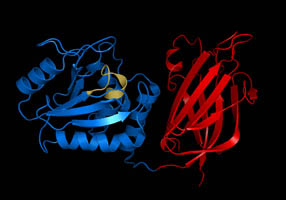
Breast cancer type 1 susceptibility protein is a protein that in humans is encoded by the BRCA1 () gene. Orthologs are common in other vertebrate species, whereas invertebrate genomes may encode a more distantly related gene. BRCA1 is a caretaker gene (responsible for repairing DNA), a type of tumor suppressor gene.
Nº Q17487737 ★★
Uncommon · Knowledge
BRCA1
Mammalian protein found in Homo sapiens
Breast cancer type 1 susceptibility protein is a protein that in humans is encoded by the BRCA1 () gene. Orthologs are common in other vertebrate species, whereas invertebrate genomes may encode a more distantly related gene. BRCA1 is a caretaker gene (responsible for repairing DNA), a type of tumor suppressor gene.
From Wikipedia
Breast cancer type 1 susceptibility protein is a protein that in humans is encoded by the BRCA1 () gene. Orthologs are common in other vertebrate species, whereas invertebrate genomes may encode a more distantly related gene. BRCA1 is a caretaker gene (responsible for repairing DNA), a type of tumor suppressor gene. BRCA1 and BRCA2 are unrelated proteins, but both are normally expressed in the cells of breast and other tissues, where they help repair damaged DNA, or destroy cells if DNA cannot be repaired. They are involved in the repair of chromosomal damage with an important role in the error-free repair of DNA double-strand breaks. If BRCA1 or BRCA2 itself is damaged by a BRCA mutation, damaged DNA is not repaired properly, and this increases the risk for breast cancer. BRCA1 and BRCA2 have been described as "breast cancer susceptibility genes" and "breast cancer susceptibility proteins". The predominant allele has a normal, tumor-suppressive function, whereas high penetrance mutations in these genes cause a loss of tumor-suppressive function, which correlates with an increased risk of breast cancer. BRCA1 combines with other tumor suppressors, DNA damage sensors and signal transducers to form a large multi-subunit protein complex known as the BRCA1-associated genome surveillance complex (BASC). The BRCA1 protein associates with RNA polymerase II, and through the C-terminal domain, also interacts with histone deacetylase complexes. Thus, this protein plays a role in transcription, and DNA repair of double-strand DNA breaks ubiquitination, transcriptional regulation as well as other functions. Methods to test for the likelihood of a patient with mutations in BRCA1 and BRCA2 developing cancer were covered by patents owned or controlled by Myriad Genetics. Myriad's business model of offering the diagnostic test exclusively led from Myriad being a startup in 1994 to being a publicly traded company with 1200 employees and about...
Text: Wikipédia, CC BY-SA 4.0. · Image: Emw (CC BY-SA 3.0) ·
Related cards
-

BRCA2
Mammalian protein found in Homo sapiens
Nº Q421651 ★
Not listed
-

BRCA mutation
Medical condition
Nº Q4836333 ★
Not listed
-
PTEN (gene)
Tumor suppressor gene
Nº Q416356 ★
Not listed
-

Bloom syndrome protein
Mammalian protein found in Homo sapiens
Nº Q885306 ★★★
Not listed
-

Alpha-1 antitrypsin
Mammalian protein found in Homo sapiens
Nº Q292982 ★
Not listed
-

Kisspeptin
Mammalian protein found in Homo sapiens
Nº Q909371 ★
Not listed