


Hamming weight
Number of nonzero symbols in a string
The Hamming weight of a string is the number of symbols that are different from the zero-symbol of the alphabet used. It is thus equivalent to the Hamming distance from the all-zero string of the same length.
Nº Q5645805 ★★
Uncommon · Knowledge
Hamming weight
Number of nonzero symbols in a string
The Hamming weight of a string is the number of symbols that are different from the zero-symbol of the alphabet used. It is thus equivalent to the Hamming distance from the all-zero string of the same length.
From Wikipedia
The Hamming weight of a string is the number of symbols that are different from the zero-symbol of the alphabet used. It is thus equivalent to the Hamming distance from the all-zero string of the same length. For the most typical case, a given set of bits, this is the number of bits set to 1, or the digit sum of the binary representation of a given number and the ℓ₁ norm of a bit vector. In this binary case, it is also called the population count, popcount, sideways sum, or bit summation.
Text: Wikipédia, CC BY-SA 4.0. · Image: Laurence R. Ugalde URL: https://formulae.org/?script=example... (CC BY-SA 4.0) ·
Related cards
-

Hamming distance
Number of bits that differ between two strings
Nº Q272172 ★★
Not listed
-

Hamming(7,4)
Linear error-correcting code
Nº Q2322550 ★
Not listed
-

Byte
Unit of digital information equal to 8 bits
Nº Q8799 ★★★★
Not listed
-
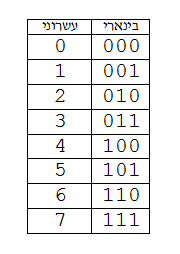
Binary number
System that represents numeric values using two symbols; 0 or 1
Nº Q3913 ★★★★
Not listed
-

1-bit computing
Computer architecture bit width
Nº Q161583 ★
Not listed
-
P
Petabit
Unit of digital information equal to one quadrillion bits or 1,000 terabits
Nº Q1152074 ★
Not listed