

Common · Knowledge
Probability amplitude
Complex number whose squared absolute value is a probability
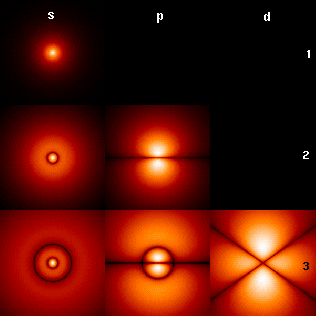
In quantum mechanics, a probability amplitude is a complex number used for describing the behaviour of systems. The square modulus of this quantity at a point in space represents a probability density at that point.
From Wikipedia
In quantum mechanics, a probability amplitude is a complex number used for describing the behaviour of systems. The square modulus of this quantity at a point in space represents a probability density at that point. Probability amplitudes provide a relationship between the quantum state of a system and the results of observations of that system, a link that was first proposed by Max Born, in 1926. Interpretation of values of a wave function as the probability amplitude is a pillar of the Copenhagen interpretation of quantum mechanics. In fact, the properties of the space of wave functions were being used to make physical predictions (such as emissions from atoms being at certain discrete energies) before any physical interpretation of a particular function was offered. Born was awarded half of the 1954 Nobel Prize in Physics for this understanding, and the probability thus calculated is sometimes called the "Born probability". These probabilistic concepts, namely the probability density and quantum measurements, were vigorously contested at the time by the original physicists working on the theory, such as Schrödinger and Einstein. It is the source of the mysterious consequences and philosophical difficulties in the interpretations of quantum mechanics—topics that continue to be debated even today.
Text: Wikipédia, CC BY-SA 4.0. · Image: Geek3 (CC BY-SA 3.0) ·
Related cards
-
P★
Probability current
Quantity describing the flow of probability per unit time per unit area
-
B★
Bell state
Quantum state of two qubits that exhibits maximal quantum entanglement
-
 ★★★★
★★★★
Quantum
Minimum positive amount of any physical property involved in an interaction
-
 ★★★★
★★★★
Many-worlds interpretation
Interpretation of quantum mechanics which denies the collapse of the wavefunction
-
 ★
★
Quantum statistical mechanics
Statistical mechanics of quantum-mechanical systems
-
R★
Relational quantum mechanics
Interpretation of quantum mechanics which treats the state of a quantum system as the relation between the observer and the system